Anthony Edwards is 6 feet 4 inches tall (193 cm), according to Basketball-Reference and the NBA’s own listings. That is the official number, and it has stayed the same across every major database that tracks the Minnesota Timberwolves guard — NBA.com, ESPN, StatMuse and Basketball-Reference all list him at 6 ft 4 in and 225 lb (102 kg). He was born on August 5, 2001, in Atlanta, Georgia, which makes him 25 years old as of November 2026.
The short answer settles the search, but it does not explain why so many fans think he looks taller. Edwards plays bigger than his listed height. He carries a 6 ft 9 in wingspan, a reported 41.5-inch vertical leap, and a 225 lb frame built more like a football player than a typical shooting guard. Put those numbers together and you get a guard who dunks over centres, guards three positions, and finishes through contact that would stop most players his size. This page gives the full picture: the official measurement, where the 6 ft 5 in and 6 ft 6 in claims come from, how he stacks up against the league’s other stars, and what his size has meant for his career and his money — including the five-year, $244.6 million extension that made him the face of the Timberwolves. Last updated November 17, 2026.
Quick Facts: Anthony Edwards
| Full Name | Anthony Edwards |
|---|---|
| Height | 6 ft 4 in (193 cm) — Basketball-Reference, NBA.com, ESPN |
| Weight | 225 lb (102 kg) |
| Wingspan | 6 ft 9 in (206 cm); some pre-draft listings say 6 ft 10 in |
| Standing Reach | 8 ft 4 in (100 in) |
| Vertical Leap | 41.5 inches (reported) |
| Date of Birth | August 5, 2001 (age 25 in November 2026) |
| Birthplace | Atlanta, Georgia, USA |
| Team | Minnesota Timberwolves |
| Position | Shooting guard |
| Jersey Number | 5 |
| Draft | No. 1 overall pick, 2020 NBA Draft |
| College | Georgia Bulldogs (2019–20, one season) |
| Estimated Net Worth | $40 million (2026 estimate; range $40–$45 million) |
| Contract | Five-year, $244.6 million extension (2023, through 2028–29) |
| Nickname | Ant-Man / Ant |
Table of Contents
- How Tall Is Anthony Edwards?
- The Official Measurements, All in One Place
- Why Some Sources Say 6 ft 5 in or 6 ft 6 in
- Anthony Edwards Height vs Other NBA Stars
- Early Life in Atlanta
- One Season at Georgia
- The 2020 Draft and Rookie Season
- The Rise to All-Star and All-NBA
- How His Height and Length Shape His Game
- The Contract and the Money Behind the Height
- Personal Life
- Setbacks and Injuries
- Frequently Asked Questions
- Final Thoughts
- Sources and Reporting

How Tall Is Anthony Edwards?
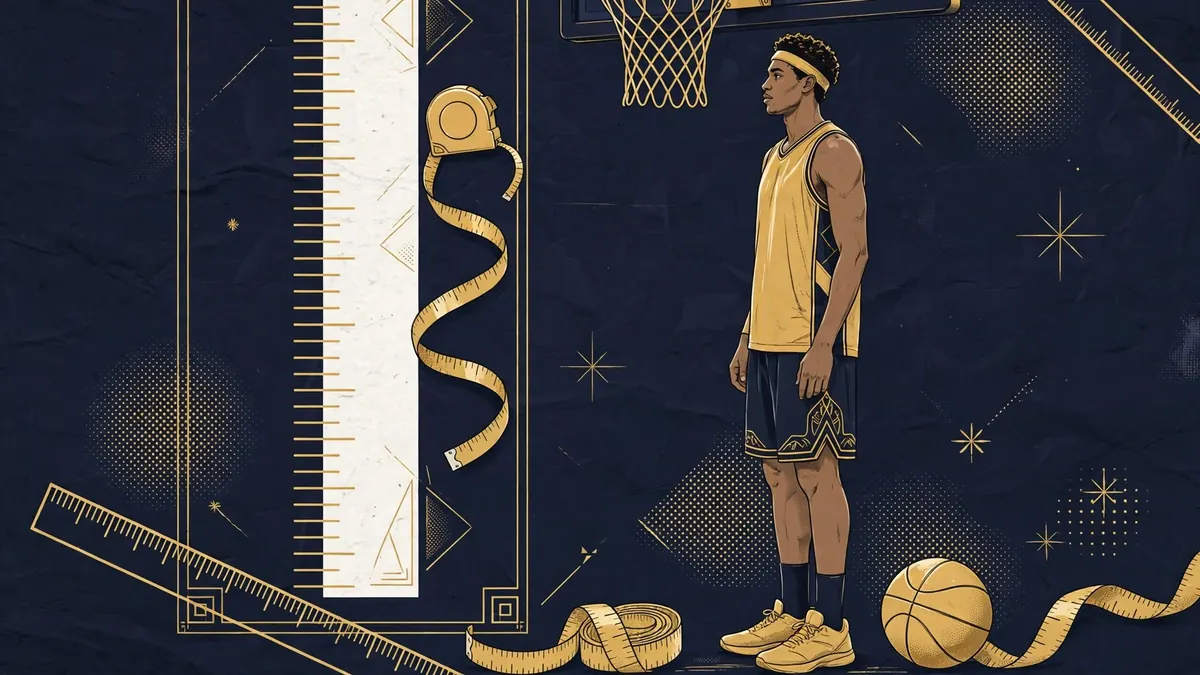
Anthony Edwards stands 6 feet 4 inches tall. In metric terms, that is 193 cm. The figure comes from the NBA’s official player listings and is repeated by Basketball-Reference, which answers its own “How tall is Anthony Edwards?” prompt with a plain “6-4 (193 cm)”. ESPN lists the same height and the same 225 lb weight, and StatMuse’s player card reads “6’4″, Height, 225 lbs, Weight”. When four independent databases agree to the inch, the number is as settled as a listed height ever gets in basketball.
That agreement matters because basketball heights have a long history of soft numbers. Teams used to round up, agents used to round up, and shoe companies had their own reasons to add an inch. The NBA changed its approach in 2019, when it started requiring teams to list heights measured without shoes. Edwards entered the league a year later, in 2020, so his 6 ft 4 in listing comes from that stricter era. It is a barefoot measurement, not an in-shoes estimate, and that single fact explains most of the confusion around his height.
For readers who think in centimetres, 193 cm puts Edwards at almost exactly the average height for an NBA shooting guard, and a couple of inches below the league-wide average of roughly 6 ft 6 in. He is not a tall player by NBA standards. He is a normal-sized guard who plays like a much bigger one, and the rest of this article is really about that gap between the tape measure and the eye test.
The number to remember: 6 ft 4 in (193 cm), 225 lb (102 kg), measured without shoes. Everything else on this page — the wingspan, the vertical, the comparisons — hangs off that one official figure.
The Official Measurements, All in One Place
A player’s height on its own tells you very little. Scouts read height together with weight, wingspan, standing reach and vertical leap, because the combination decides what a player can actually do on a court. Edwards scores well on every one of those secondary numbers, and that is why his 6 ft 4 in frame plays like a 6 ft 7 in one.
| Measurement | Value |
|---|---|
| Height (without shoes) | 6 ft 4 in (193 cm) — NBA.com, Basketball-Reference, ESPN |
| Height (with shoes, pre-draft listings) | 6 ft 5 in (196 cm) — older draft profiles |
| Weight | 225 lb (102 kg) |
| Wingspan | 6 ft 9 in (206 cm); a few pre-draft reports list 6 ft 10 in |
| Standing Reach | 8 ft 4 in (100 in) |
| Vertical Leap | 41.5 inches (reported; some outlets round it to 42 inches) |
| Hand Size | Not officially published |
The wingspan deserves a closer look. At 6 ft 9 in, Edwards’ arms stretch five inches wider than he is tall. That plus-five ratio is the kind of number scouts circle in red ink. Most people have a wingspan roughly equal to their height; a five-inch surplus is rare, and it shows up everywhere in his game — in deflections, in rebounds over taller players, and in the way he can release a jump shot over a contesting defender without needing extra space. A small number of pre-draft reports, including Sportsnet’s 2020 draft profile, list his wingspan at 6 ft 10 in instead. The honest range is therefore 6 ft 9 in to 6 ft 10 in, anchored at 6 ft 9 in because that is the figure most current databases carry.
Standing reach — how high a player can touch with one arm raised while standing flat-footed — is listed at 8 ft 4 in. Add the reported 41.5-inch vertical leap to that reach and the arithmetic gives a maximum touch of close to 11 ft 10 in, nearly two feet above the rim. That is simple addition on listed figures, not a measured test result, but it matches what fans see every week: Edwards taking off from well outside the paint and finishing above players who stand half a foot taller than him.
His weight is the other half of the story. At 225 lb, Edwards is heavier than most guards his height. Devin Booker, who stands an inch taller, is listed around 206 lb. Stephen Curry, at 6 ft 2 in, is listed around 185 lb. Edwards carries the mass of a small forward on a shooting guard’s frame, and that mass is why defenders bounce off him on drives instead of the other way round. The pre-draft scouting report on Canis Hoopus put it plainly, calling him an “athletic specimen” with “an elite NBA guard’s frame with the power and mass of a running back”.
Why Some Sources Say 6 ft 5 in or 6 ft 6 in
If you search for Anthony Edwards’ height, you will find three different answers: 6 ft 4 in, 6 ft 5 in, and occasionally 6 ft 6 in. None of them is a fabrication. Each one comes from a different measuring convention, and once you know the conventions, the disagreement disappears.
The 6 ft 5 in figure is the oldest of the three. Before the NBA tightened its listing rules in 2019, heights were routinely listed with shoes on. A basketball shoe adds roughly an inch, sometimes a little more with a thick sole. Draft profiles written in 2020 — Sportsnet’s “Prospect of Interest” piece, for example — listed Edwards at “six-foot-five” and 225 lb, and theScore’s draft coverage described “the athletic 6-foot-5, 225-pound guard”. Those profiles were written from in-shoes measurements. When the league’s without-shoes standard took over, the same player became 6 ft 4 in. Same body, different ruler.
The 6 ft 6 in claim has a different origin: a single comment from his own head coach. In 2021, Timberwolves coach Chris Finch told reporters that Edwards had grown a couple of inches since the draft and was “more like 6-6”. The remark was reported by Sporting News and has been recycled by content sites ever since. No subsequent measurement has ever backed it up. No combine re-test, no team listing, and no database has moved Edwards off 6 ft 4 in. A coach’s eye is not a tape measure, and in this case the tape measure has won every time the question has been checked since.
There is also a visual reason the taller numbers feel right. Edwards’ wingspan makes his silhouette wider than his height suggests, and his vertical leap makes him play above players who are genuinely taller. When a 6 ft 4 in guard dunks over a 6 ft 9 in forward, the brain files the guard as “about 6 ft 6 in” and moves on. Add in the fact that he often shares the court with teammates and opponents listed at 6 ft 8 in and above, and the eye test keeps arguing with the official listing. The official listing is right; the eye test is measuring wingspan and bounce, not height.
So, to settle it in one line: Anthony Edwards is 6 ft 4 in without shoes, 6 ft 5 in in shoes, and the 6 ft 6 in figure is an unmeasured coach’s remark from 2021 that no official source has ever confirmed.
Anthony Edwards Height vs Other NBA Stars
Height only means something in context. The table below puts Edwards next to the guards and forwards fans compare him with most, using each player’s commonly listed height. The pattern is plain: Edwards is shorter than the league’s superstar wings, about the same height as the great shooting guards of the past, and taller than the small guards who run today’s offences.
| Player | Listed Height |
|---|---|
| Anthony Edwards | 6 ft 4 in (193 cm) |
| Trae Young | 6 ft 1 in (185 cm) |
| Stephen Curry | 6 ft 2 in (188 cm) |
| Damian Lillard | 6 ft 2 in (188 cm) |
| Dwyane Wade | 6 ft 4 in (193 cm) |
| Devin Booker | 6 ft 5 in (196 cm) |
| Shai Gilgeous-Alexander | 6 ft 6 in (198 cm) |
| Michael Jordan | 6 ft 6 in (198 cm) |
| Kobe Bryant | 6 ft 6 in (198 cm) |
| Luka Doncic | 6 ft 7 in (201 cm) |
| LeBron James | 6 ft 9 in (206 cm) |
| Kevin Durant | 6 ft 11 in (211 cm) |
| Victor Wembanyama | 7 ft 4 in (224 cm) |
The Dwyane Wade line is the one that matters most. Wade, at the same 6 ft 4 in, built a Hall of Fame career as a slashing, dunking shooting guard who played far above his listed height, and Edwards has been compared with Wade since his draft year. The comparison is not just about height. Wade’s wingspan, strength and fearlessness at the rim are the template Edwards follows, and the numbers line up: same height, similar weight class, similar appetite for contact. When analysts call Edwards the closest thing to a young Wade, the tape measure is part of the argument.
Against today’s point guards, Edwards has a clear size edge. Trae Young stands 6 ft 1 in, three inches shorter, and Stephen Curry stands 6 ft 2 in. That gap is why Edwards can shoot over the top of smaller guards without a screen and why teams think twice before switching a small guard onto him. Against the bigger wings, the gap runs the other way: LeBron James at 6 ft 9 in gives up five inches to nobody in this conversation, and Kevin Durant at 6 ft 11 in is seven inches taller than Edwards. What closes that gap for Edwards is not height but reach and lift — his 6 ft 9 in wingspan matches LeBron’s height, and his vertical leap erases the rest at the rim.
The contrast with Victor Wembanyama, listed at 7 ft 4 in, is the extreme case: a full foot of difference. Yet Edwards has dunked on and over players in Wembanyama’s size class, which is exactly why his height draws so many searches. Fans see a guard finishing over giants and assume the guard must be a giant too. He is not. He is a 6 ft 4 in guard with a 41.5-inch vertical and arms that belong on a taller man.
One more comparison puts his size in team context. Devin Booker, listed at 6 ft 5 in, is the shooting guard Edwards is most often measured against as a scorer, and the one-inch gap between them is invisible on a court. Giannis Antetokounmpo, listed at 6 ft 11 in, shows the other end of the scale — a forward whose height and length let him play a different sport, almost, from the one Edwards plays. Edwards’ game is built to beat players like Giannis not by matching their size but by being quicker to the spot and higher at the finish.
Early Life in Atlanta
Anthony Edwards was born on August 5, 2001, in Atlanta, Georgia, and raised in the city’s Oakland City neighbourhood. He grew up in a household shaped by sport: his father played football, and Edwards himself started out as a football player, playing running back and quarterback as a boy. Basketball came second, and it came late — he did not take the game seriously until his early teens, which makes his rise to the No. 1 pick all the more striking.
His childhood was marked by loss that he still talks about in interviews. His mother, Yvette Edwards, died of cancer in January 2015, when Anthony was 13. His grandmother Shirley, who had helped raise him, died later the same year, also of cancer. The two deaths in one year reshaped his family. His older brother Antoine and older sister Antoinette took on much of his day-to-day care, and Edwards has said many times since that his mother and grandmother are the reason he plays with the edge he does — the “Believe That” phrase on his signature shoe and the peach “With Love” colourway of the AE1 both trace back to them.
At school, Edwards attended Holy Spirit Preparatory School in Atlanta, where he reclassified from the 2020 recruiting class to the 2019 class so he could reach college a year earlier. As a senior he averaged 25.7 points, 9.6 rebounds and 2.1 steals per game, according to theScore’s draft coverage, and carried Holy Spirit to the state championship game. Recruiting services ranked him among the very best players in the country — 247Sports had him as a consensus five-star recruit and, at one point, the No. 1 player in his class. The physical tools were already obvious: a 6 ft 4 in frame (listed 6 ft 5 in with shoes at the time), 225 lb, and a vertical leap that had college coaches talking before he had played a minute of college ball.
Football never fully left him. Coaches and scouts still describe his game in football terms — burst, contact balance, power through traffic — and Edwards himself has joked that he might have been a football player if basketball had not worked out. The running-back build is not an accident of training. It is the body he grew up with, and it is the reason a guard his height can absorb hits at the rim that would send lighter guards to the floor.
One Season at Georgia
Edwards committed to the University of Georgia in February 2019, becoming the highest-rated recruit in the programme’s history. He played one season for the Bulldogs, 2019–20, and it was enough. He averaged 19.1 points, 5.2 rebounds and 2.8 assists per game, led the nation in scoring among freshmen, and finished with 610 total points — the 10th-most ever by a freshman in SEC history and the seventh-highest single-season total by any Bulldog, according to the University of Georgia’s own athletics site.
The season had a signature night early on. In his sixth college game, against No. 3 Michigan State at the Maui Invitational in November 2019, Edwards scored 37 points with six rebounds, four steals and three blocks, including 33 points in the second half, dragging Georgia back from a 21-point deficit. The performance, against the No. 3 team in the country, is still the game scouts cite when they explain why a player from a 16–16 team went first overall. Georgia finished 16–16 and second from bottom in the SEC, and the NCAA Tournament was cancelled that spring, so Edwards never played a postseason college game. None of that dented his draft stock.
The honours at the end of that single season tell the story: SEC Freshman of the Year, voted by the league’s coaches and named SEC Newcomer of the Year by the Associated Press, second-team All-SEC, and SEC Freshman of the Week four times — a school record for a first-year player. He declared for the 2020 NBA Draft in March 2020, after one year in Athens, and never looked back.
The 2020 Draft and Rookie Season
The Minnesota Timberwolves selected Anthony Edwards with the first overall pick in the 2020 NBA Draft on November 18, 2020, making him the highest-drafted player in Georgia history — ahead of Dominique Wilkins, who went third overall in 1982. He signed a standard four-year rookie contract worth $44.2 million, the scale deal for a No. 1 pick, and made his NBA debut on December 23, 2020.
His rookie season answered the only real question about him: could a 19-year-old who had shot 40.2 percent from the field in college score efficiently against NBA defences? He led all qualified rookies in scoring at 19.3 points per game, the highest rookie scoring average in Timberwolves history, and finished second in Rookie of the Year voting behind LaMelo Ball. He was a unanimous selection to the NBA All-Rookie First Team. The dunks arrived immediately — he finished his rookie year with a poster dunk over Yuta Watanabe in February 2021 that is still replayed whenever his athleticism comes up — and so did the sense that Minnesota had found its next franchise player after years of searching.
What stood out even then was how little his height limited him. Rookie Edwards was already guarding bigger wings, rebounding like a forward (he averaged 4.7 rebounds as a rookie and has hovered around five a game since), and finishing through contact. The 6 ft 4 in listing never looked like a problem because the 6 ft 9 in wingspan and the 225 lb frame did the work that height usually does.
The Rise to All-Star and All-NBA
Edwards’ climb has been steady rather than sudden, which is part of why the numbers hold up under checking. In 2021–22 he raised his scoring to 21.3 points per game and helped Minnesota back to the playoffs. In 2022–23 he averaged 24.6 points, 5.8 rebounds and 4.4 assists and was named an NBA All-Star for the first time. In 2023–24 he averaged a then career-best 25.9 points with 5.4 rebounds and 5.1 assists, earned his second All-Star selection and his first All-NBA Second Team honour, and led the Timberwolves to the Western Conference Finals for the first time in 20 years. In 2024–25 he went further still: a career-best 27.6 points per game, a third All-Star selection, a second straight All-NBA Second Team place, and a second straight trip to the Western Conference Finals.
The international stage added the missing piece. Edwards played for the United States at the 2023 FIBA World Cup, where he was the team’s leading scorer, and then at the Paris 2024 Olympics, where he averaged 12.8 points in just over 16 minutes per game, shot 58 percent from the field, scored 26 points against Puerto Rico, and won a gold medal as part of a roster that included LeBron James, Stephen Curry and Kevin Durant. Celebrity Net Worth’s 2026 update credits him with a fourth straight All-Star selection through 2026 and with winning the Kobe Bryant Trophy as NBA All-Star Game MVP in February 2026 — the kind of honour that confirms a player has moved from rising star to face of the league.
Through the 2025–26 season, his career averages sit around 24.6 points, 5.2 rebounds and 4.1 assists per game across more than 440 regular-season games, per StatMuse, with four All-Star selections on his record by the 2026–27 season. The scoring growth is the story: 19.3 points as a rookie, 21.3, then 24.6, 25.9, 27.6. Each step up came with more defensive attention, more double teams, and more responsibility — and each time, the production went up anyway.
How His Height and Length Shape His Game
Edwards’ game is a case study in how a guard turns average height into an advantage. The first place it shows is at the rim. A 6 ft 4 in guard with a 41.5-inch vertical and a 6 ft 9 in wingspan does not need a clear lane to dunk; he needs a half-step. Defenders who are taller than him still have to time their jump perfectly, because Edwards gets off the floor faster and reaches higher at the peak of his jump. The result is a highlight reel full of dunks over players who look, on paper, too tall to be dunked on.
The second place it shows is on defence. A 6 ft 9 in wingspan lets Edwards guard three positions: point guards he can smother, shooting guards he can match, and small forwards he can at least bother. His 225 lb frame means bigger wings cannot simply back him down, and his quick feet mean smaller guards cannot simply run past him. That switchability is why Minnesota trusts him on the opponent’s best perimeter player in big moments, and why his steal and block numbers — around 1.3 steals and 0.6 blocks a game for his career — understate his defensive value. The deflections and contested shots do not always make the box score.
The third place is rebounding. Edwards averages around five rebounds a game, a strong number for a shooting guard, and the reason is the same combination: length plus strength plus bounce. He rebounds outside his area because his arms reach balls other guards cannot touch, and he holds his ground once he gets there because of the 225 lb frame. For a team that plays him heavy minutes — he has averaged close to 35 minutes a game across his career — those extra possessions add up across a season.
The fourth place is shooting. Height is often treated as a shooting advantage, and it is — taller players shoot over contests more easily. Edwards compensates with elevation: his jump shot leaves his hands at a height that a flat-footed 6 ft 6 in defender cannot reach, because the 41.5-inch leap is built into the shot. His three-point volume has grown every year of his career, and by 2024–25 he was one of the league’s most prolific three-point shooters, a development nobody predicted from his college percentages. The shot is not a product of his height. It is a product of work — but his height never stopped it from working.
There is one honest limit, and it is worth stating. At 6 ft 4 in, Edwards will always give up size to the league’s great wings and forwards in a straight post-up or a contested rebound in traffic. He handles that by not playing that game: he beats bigger players with speed, with elevation, and with the strength to finish through them rather than over them. The limit is real, but it has not capped his production, and the All-NBA selections suggest the league’s coaches and media agree.

The Contract and the Money Behind the Height
Height does not pay a basketball player. Production does — but in Edwards’ case, the production his physical gifts unlocked is exactly what the Timberwolves paid for. In July 2023, Minnesota signed him to a five-year designated rookie maximum extension worth $244.6 million, fully guaranteed, running through the 2028–29 season. Spotrac, the contract database most outlets cite, lists the deal at $244,623,120 guaranteed with an average annual salary of $48,924,624, and notes it can rise toward $260 million if Edwards meets performance escalators such as All-NBA selections.
| Season | Salary (Spotrac) |
|---|---|
| 2024–25 | $42,176,400 |
| 2025–26 | $45,550,512 |
| 2026–27 | $48,924,624 |
| 2027–28 | $52,298,736 |
| 2028–29 | $55,672,848 |
Before the extension, Edwards earned $86.4 million in career NBA salary alone as of May 2025, according to Spotrac — that figure covers his four-year, $44.2 million rookie deal plus the first year of the extension. By the time the extension runs out in 2029, his on-court career earnings will pass $288 million. His 2025–26 salary of $45.55 million already places him among the highest-paid guards in the league, and the deal rises every year until it reaches $55.67 million in its final season.
His net worth is a separate, smaller number, because net worth is what is left after tax, spending, agents and investments — not the sum of contract values. Celebrity Net Worth and ClutchPoints both put Edwards’ net worth at about $40 million in 2026, and a handful of other trackers land at $45 million, so the honest range is $40–$45 million, anchored at $40 million. Forbes has put his total income from salary plus endorsements at roughly $62 million in 2025, which fits the picture: a player early in a quarter-billion-dollar deal whose wealth is still catching up with his earnings. For the full money breakdown, our sister site covers Anthony Edwards’ net worth in detail, including the contract year by year and the endorsement portfolio.
Endorsements are the second engine of his wealth. Edwards signed with Adidas in December 2020, shortly after being drafted, and the relationship became far more valuable in July 2024, when he signed a multi-year extension. The Athletic’s Shams Charania reported the extension pays “eight figures annually” — at least $10 million a year — and named Edwards a face of the Adidas brand. No total value has ever been confirmed by Adidas or by Edwards’ camp, and outlets that print one are guessing; the eight-figures-a-year figure is the only number with a named source behind it. His first signature shoe, the AE1, launched on December 16, 2023, at $120, became one of the best-selling basketball shoes in the country, and was named Sneaker of the Year for 2024 by Complex — the first time in a decade a performance basketball shoe had taken that title. The AE2 followed, along with a budget line, the “Believe That. 1”, at $100.
Beyond Adidas, Edwards holds deals with Sprite, Bose, Gatorade, AT&T, Panini, Call of Duty, Chipotle and Fanatics, and has appeared in Prada campaigns. None of those deals carries a publicly disclosed dollar figure, so this article will not invent one. On the business side, he runs AE5 Enterprises with his business partner Justin Holland, and the pair also run the Don’t Follow the Wave foundation. The pattern is familiar for a young star: the shoe deal is the headline, the rest of the portfolio is the quiet compounding underneath it.
Personal Life
Edwards guards his private life more closely than most stars his age, but the outlines are public. He is the youngest of three siblings, raised in Atlanta by his older brother Antoine and older sister Antoinette after their mother and grandmother died in 2015. He has spoken often about his mother Yvette’s influence — the peach colourway of his AE1, “With Love”, is a nod to her favourite colour — and about the responsibility he felt as the youngest child in a family that had lost its two matriarchs in a single year.
He became a father in 2024, a change he has described as a new motivation rather than a distraction, and he keeps the details of his family life largely out of interviews. Away from basketball, his closest professional relationship is with Justin Holland, his business partner in AE5 Enterprises and co-founder of the Don’t Follow the Wave foundation, which works with young people in Atlanta and Minneapolis. The foundation’s name is a piece of advice Edwards repeats often: do not follow the crowd, set your own course. It is also, in a quiet way, a description of his career so far — a 6 ft 4 in guard who refused to play like one was supposed to.
His life off the court is also where his Atlanta roots show most clearly. He still talks about Oakland City, still works with young players from the neighbourhood, and still carries the habits of a kid who grew up playing football before basketball. The flash — the dunks, the trash talk, the celebrations — gets the attention. The steadier part of the story is a player who lost his mother at 13, was raised by his siblings, and turned that loss into the fuel for a career that now carries a franchise.
Setbacks and Injuries
Edwards’ career has not been free of trouble, and the record is worth stating plainly. In April 2023, after the Timberwolves’ Game 5 playoff loss to the Denver Nuggets, he threw a chair in frustration on his way to the locker room; the chair struck two bystanders, and the NBA fined him $50,000. He apologised, paid the fine, and the incident has not been repeated. It is the one disciplinary mark on his record, and it is also the moment most often cited when people discuss his maturity — fairly or not — because it happened on a playoff stage.
Injuries have been lighter than for most players with his workload. He has dealt with recurring ankle soreness, including a rolled left ankle in a November 2025 game against Denver that left him day-to-day with a mild lateral sprain after X-rays came back negative. In the 2026 playoffs, again against Denver, he hyperextended his left knee in Game 4 and sustained a bone bruise. Neither episode cost him a long stretch, which is notable for a player whose game is built on explosive jumping and hard landings. Durability, so far, has been one of his quiet strengths: he has played more than 440 regular-season games since his debut, and his minutes load — close to 35 a game across his career — has not yet produced a serious long-term injury.
Frequently Asked Questions
How tall is Anthony Edwards?
Anthony Edwards is 6 feet 4 inches tall (193 cm), according to Basketball-Reference, NBA.com and ESPN. He weighs 225 lb (102 kg). The measurement is taken without shoes, under the NBA’s listing rules that have applied since 2019.
Is Anthony Edwards 6 ft 5 in or 6 ft 6 in?
Neither figure is his official height. The 6 ft 5 in listing comes from older pre-draft profiles that measured him with shoes on, which adds about an inch. The 6 ft 6 in claim comes from a 2021 remark by Timberwolves coach Chris Finch, who said Edwards had grown a couple of inches — no measurement has ever confirmed it, and every official database still lists him at 6 ft 4 in.
How much does Anthony Edwards weigh?
Anthony Edwards weighs 225 lb (102 kg). That is heavy for a 6 ft 4 in guard — Devin Booker, an inch taller, is listed around 206 lb — and the extra mass is a big part of why Edwards finishes through contact at the rim instead of avoiding it.
What is Anthony Edwards’ wingspan?
Anthony Edwards’ wingspan is 6 feet 9 inches (206 cm), five inches wider than his height. A few pre-draft reports list it at 6 ft 10 in, so the honest range is 6 ft 9 in to 6 ft 10 in, anchored at 6 ft 9 in. His standing reach is listed at 8 ft 4 in.
What is Anthony Edwards’ vertical jump?
Anthony Edwards’ vertical leap is reported at 41.5 inches, a figure attributed to Bleacher Report’s Jake Fischer in pre-draft coverage. Some outlets round it to 42 inches. Combined with his 8 ft 4 in standing reach, it gives him a maximum touch of close to 11 ft 10 in — nearly two feet above the rim.
How old is Anthony Edwards?
Anthony Edwards is 25 years old as of November 2026. He was born on August 5, 2001, in Atlanta, Georgia, and turned 25 on August 5, 2026. He was the No. 1 overall pick in the 2020 NBA Draft at age 19.
How tall is Anthony Edwards compared to LeBron James and other NBA stars?
Edwards, at 6 ft 4 in, is five inches shorter than LeBron James (6 ft 9 in), seven inches shorter than Kevin Durant (6 ft 11 in) and a full foot shorter than Victor Wembanyama (7 ft 4 in). He is the same height as Dwyane Wade (6 ft 4 in), an inch shorter than Devin Booker (6 ft 5 in), and two to three inches taller than Stephen Curry (6 ft 2 in) and Trae Young (6 ft 1 in). His 6 ft 9 in wingspan and 41.5-inch vertical close much of that gap on the court.
What is Anthony Edwards’ net worth and salary?
Anthony Edwards’ net worth is estimated at about $40 million in 2026, with a range of $40–$45 million across trackers including Celebrity Net Worth and ClutchPoints. His salary for the 2025–26 season is $45,550,512 under a five-year, $244.6 million Timberwolves extension signed in July 2023, per Spotrac, and his Adidas endorsement extension pays eight figures a year, according to The Athletic.
Final Thoughts
Anthony Edwards is 6 ft 4 in tall — not 6 ft 5 in, not 6 ft 6 in, and not the giant his highlights suggest. The number is settled, sourced, and consistent across every database that matters. What makes the question worth a full article is everything the number fails to capture: a 6 ft 9 in wingspan, a 41.5-inch vertical, a 225 lb frame, and a game built on the gap between what the tape measure says and what the eye sees. Edwards turned a normal-sized guard’s body into a franchise cornerstone, a $244.6 million contract, an Olympic gold medal, All-NBA honours and a signature shoe that won Sneaker of the Year. Height got him in the door. Length, lift, strength and work did the rest — and that is why, years from now, nobody will remember Anthony Edwards as a 6 ft 4 in guard. They will remember him as the guard who played like he was 6 ft 7 in. For more star profiles, browse the celebrity section on CelebAmerica.
Sources and Reporting
How we estimated: Height, weight and wingspan figures in this article are taken from official and database sources — Basketball-Reference, NBA.com and ESPN — and are given as listed measurements without shoes, per the NBA’s post-2019 standard. Where sources disagree (wingspan 6 ft 9 in vs 6 ft 10 in, vertical 41.5 in vs 42 in, net worth $40 million vs $45 million), this article publishes the range and names the source that anchors it. Contract figures are from Spotrac. Net worth figures are third-party estimates from Celebrity Net Worth and ClutchPoints, not audited disclosures, and the true figure is private. This article was researched from live sources in November 2026 and will be updated if the NBA or the Timberwolves publish a new official measurement.
Sources consulted: Basketball-Reference, NBA.com, ESPN, Spotrac, Celebrity Net Worth, University of Georgia Athletics, The Athletic. Byline: Celebamerica Editorial Staff. Last updated November 17, 2026.