Last updated: November 17, 2026 | By Celebamerica Editorial Staff
Steve Harvey is one of the most recognisable faces on American television, and his life story reads like a manual on refusing to quit. Born Broderick Stephen Harvey on January 17, 1957, in Welch, West Virginia, he went from sleeping in his car on about $50 a week to hosting Family Feud for more than a decade and a half, and building a fortune that Celebrity Net Worth puts at $200 million as of October 2026.
This biography covers the whole arc: the coal-mining town childhood, the three years living in a 1976 Ford Tempo, the stand-up grind, the sitcom years, the Kings of Comedy breakthrough, the Family Feud era, the books, the radio empire, the company he built around his own name, and the family life that holds it together. Every money figure below is tied to a named source, and where sources disagree, the range is stated plainly rather than smoothed over.
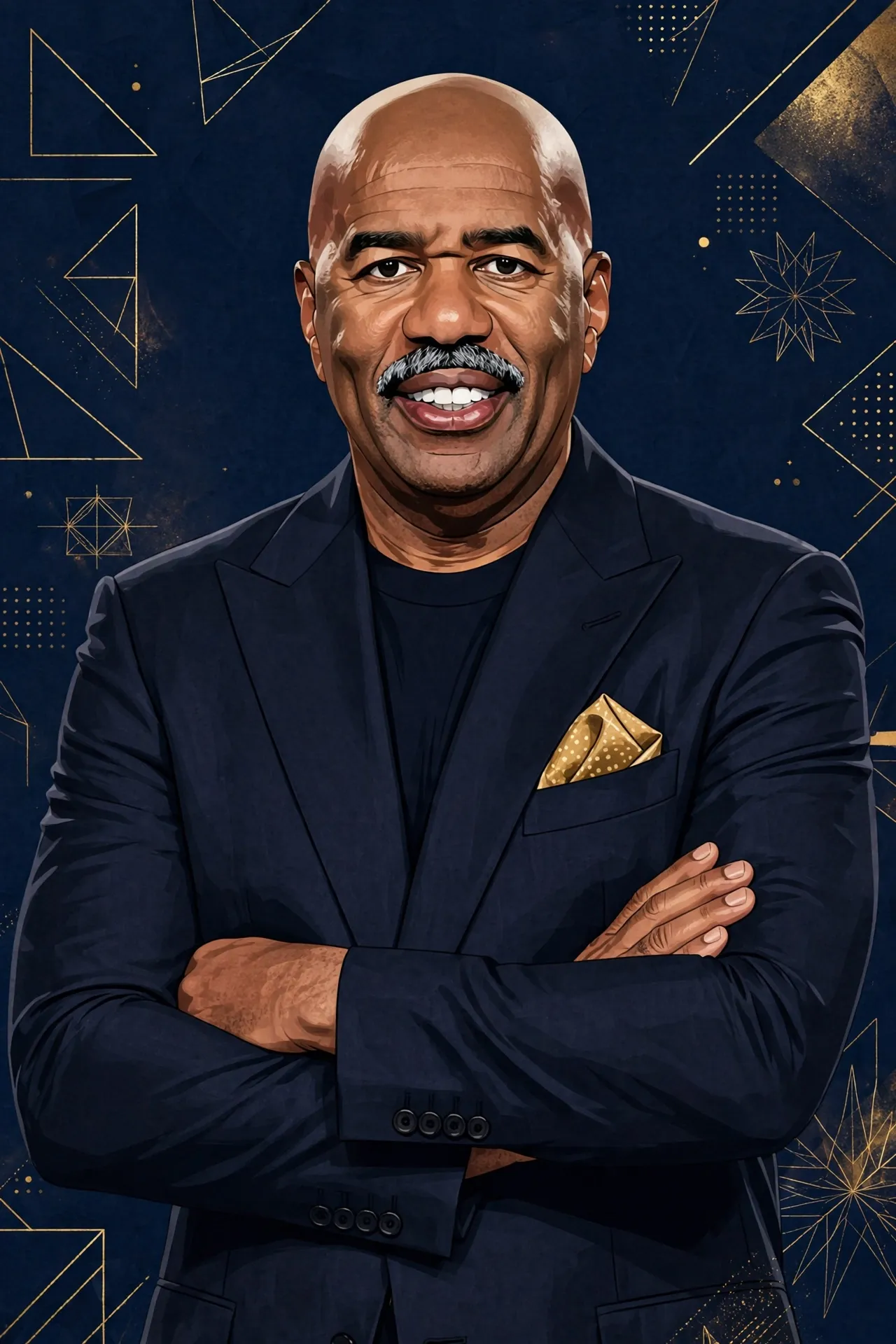
| Full Name | Broderick Stephen Harvey |
|---|---|
| Date of Birth | January 17, 1957 (age 69 in 2026) |
| Birthplace | Welch, West Virginia, United States |
| Height | 6 ft 2 in (1.88 m) |
| Estimated Net Worth | $200 million (Celebrity Net Worth, updated October 22, 2026; likely range $150M–$240M — see the money section) |
| Primary Income Sources | Family Feud and Celebrity Family Feud, The Steve Harvey Morning Show, books, production and licensing through Steve Harvey Global |
| Key Works | Family Feud (host since 2010), The Steve Harvey Show (1996–2002), The Original Kings of Comedy (2000), Act Like a Lady, Think Like a Man (2009), Judge Steve Harvey |
| Spouse | Marjorie Bridges Harvey (married June 25, 2007) |
| Children | Seven — four biological children and three stepchildren he adopted |
| Company | Steve Harvey Global (founded 2017) |
Table of Contents
- Early Life: A Coal Miner’s Son From Welch, West Virginia
- The Stand-Up Years: Three Years Sleeping in a Car
- The Breakthrough: The Steve Harvey Show and Kings of Comedy
- Family Feud: The Job That Changed Everything
- Radio, Books and the Morning Show Empire
- Steve Harvey Global and the Business Empire
- How the Money Adds Up: Income Streams and Salary
- Net Worth Growth: Year by Year
- Homes and Real Estate
- Personal Life: Marriages, Seven Children and Family
- The Miss Universe Mistake and the Comeback
- Giving Back: Mentoring and the Disney Dreamers Academy
- Frequently Asked Questions
- Final Thoughts
- Sources and Reporting
Early Life: A Coal Miner’s Son From Welch, West Virginia
Broderick Stephen Harvey was born on January 17, 1957, in Welch, a small coal town in McDowell County, West Virginia. His father, Jesse Harvey, worked as a coal miner. His mother, Elaine Harvey, taught Sunday school. The family later moved to Cleveland, Ohio, where Steve grew up on East 112th Street — a street the city would rename Steve Harvey Way in 2015, in honour of the boy who left it with nothing and came back a star.
Harvey has spoken often about the lessons of that childhood: a working-class home, a father who rose before dawn for the mines, and a mother who drilled into her children that faith and hard work were not optional. He attended Glenville High School in Cleveland, then went on to Kent State University and West Virginia University. He left both without a degree — a fact he has never hidden, and one he brings up when he talks to young people about there being more than one route to a career.
Before comedy, Harvey held a string of ordinary jobs: he worked as a boxer, an autoworker, an insurance salesman, a carpet cleaner and a mailman. None of them stuck. What stuck was the itch to make people laugh — an itch he finally scratched on October 8, 1985, when he walked onto the stage of the Hilarities Comedy Club in Cleveland for his first stand-up set. He was 28 years old, married with children, and about to bet everything on a talent he had never been paid for.
That bet nearly broke him. In the late 1980s, chasing gigs that paid little or nothing, Harvey spent roughly three years living in his 1976 Ford Tempo, washing up in gas-station bathrooms and showering at public swimming pools, surviving on about $50 a week. He has told the story many times since, not as a boast but as a warning and a promise: the car years were the price of the career, and the career only arrived because he refused to go home and take a regular job. It is the part of his biography that explains everything that came after — the work ethic, the multiple jobs at once, and the decision, decades later, to own his own company rather than rent himself out to one.
The Stand-Up Years: Three Years Sleeping in a Car
Harvey’s stand-up career began slowly and then, in the early 1990s, accelerated. In 1990 he reached the finals of the Johnnie Walker National Comedy Search, a national showcase that put him in front of television executives for the first time. The same year he landed a hosting job on It’s Showtime at the Apollo, the long-running variety series filmed at Harlem’s Apollo Theater, which he hosted from 1993 to 2000. The Apollo stage was a proving ground: a tough, famously honest crowd, and a weekly national audience.
His comedy was observational and clean enough for network television but sharp enough for the club circuit — routines about relationships, family, work and the gap between what men say and what they mean. That voice would later become the engine of his best-selling books. Fellow comedians of his generation were making the same climb at the same time, and the era produced a whole wave of Black stand-up stars who crossed into television; the career of Eddie Murphy, who had made the same leap from stand-up stages to mainstream stardom a decade earlier, is the closest parallel in scale.
By the mid-1990s Harvey was a regular on the comedy-club circuit and a familiar face on television, but he was still years away from real money. The car years were behind him; the lean years were not. He kept taking every stage he could get, and in 1996 the break finally came in the form of his own sitcom.
The Breakthrough: The Steve Harvey Show and Kings of Comedy
The Steve Harvey Show premiered on The WB in 1996 and ran for six seasons until 2002. Harvey played Steve Hightower, a former 1970s funk musician turned high-school music teacher and vice principal, opposite Cedric the Entertainer as his best friend Cedric Robinson. The show was a steady ratings performer for the young network, and it gave Harvey something stand-up never had: a weekly paycheque, a character the audience knew by name, and a platform that reached far beyond the comedy clubs.
The sitcom also cemented the partnership with Cedric the Entertainer, who would become one of Harvey’s closest collaborators. In 2000, the two joined D.L. Hughley and Bernie Mac for The Original Kings of Comedy, a concert film directed by Spike Lee that captured their live tour. The film was a box-office hit and a cultural moment — four Black comedians selling out arenas with a two-hour stage show, filmed and released theatrically. For Harvey, it was the moment his stand-up career peaked and, in a sense, ended: after the Kings tour, television hosting and acting would take over, and he would rarely return to the club stage.
Film roles followed — The Fighting Temptations (2003), Love Don’t Cost a Thing (2003), Johnson Family Vacation (2004) — but none of them defined him the way television did. By the mid-2000s, Harvey’s career was in transition: the sitcom was over, the film work was sporadic, and the next chapter had not yet arrived. It arrived in two parts — a radio show and a book — that together rebuilt him into something bigger than an actor or a comic.
Family Feud: The Job That Changed Everything
In September 2010, Harvey took over as host of Family Feud, the long-running survey-based game show. It was, on paper, a modest gig — a daytime game show with a rotating cast of hosts. In practice, it became the defining job of his career. Harvey’s reactions to contestants’ answers — the long stares, the disbelief, the way he let a bad answer hang in the air — turned the show into appointment viewing and made clips of it a permanent fixture of social media. By the show’s 50th-anniversary season in 2026, producers were anticipating that Harvey would pass 3,000 episodes as host, making him by far the longest-serving host in the show’s history.
The Feud paycheck is the anchor of his income. Celebrity Net Worth has long estimated that Harvey earns at least $10 million a year from Family Feud, across roughly 180 episodes a season. That works out to something in the region of $50,000–$55,000 per episode, though the per-episode figure is a derived estimate, not a published contract number, and Parade has reported a wider range of estimates for his per-episode pay. The spin-off, Celebrity Family Feud, has run since 2015 and added a prime-time paycheque on top of the daytime show.

Harvey’s hosting style also reshaped the show itself. Under previous hosts the format was brisk and forgettable; under Harvey it became a personality vehicle, with the host’s reactions often outdrawing the game. Other television hosts built similar empires around a single format — Simon Cowell, for instance, turned judging talent shows into a production and licensing business — but few hosts have stayed with one show as long as Harvey has stayed with Feud. The longevity matters for the money: a host who stays 16 years negotiates from strength every time the contract comes up.
Beyond Feud, Harvey’s hosting résumé kept growing: Little Big Shots (2016–2019), his own daytime talk show Steve (2017–2019), Steve Harvey’s Funderdome, a revival of Showtime at the Apollo, and Judge Steve Harvey, which began in 2022. He also hosted the Miss Universe pageant in 2015, 2016, 2017, 2018, 2019 and 2021 — a run best remembered for its first night, covered later in this biography.
Radio, Books and the Morning Show Empire
If Family Feud made Harvey famous again, radio made him rich. The Steve Harvey Morning Show, nationally syndicated, reaches millions of listeners a week and is estimated by Celebrity Net Worth at roughly $20 million a year — the single largest line in his annual earnings, ahead of Feud itself. The show mixes comedy, music, interviews and Harvey’s straight-talk advice segments, and it has run for more than two decades, outlasting most of the radio careers it was launched alongside.

The book that changed his career arrived in 2009. Act Like a Lady, Think Like a Man became a number-one New York Times bestseller, turning Harvey’s stage routines about relationships into a publishing franchise. A film adaptation, Think Like a Man (2012), followed, along with sequels including Straight Talk, No Chaser (2010) and Act Like a Success, Think Like a Success (2014). The books did more than sell copies: they repositioned Harvey from comedian to adviser, a man audiences trusted with their relationships and their ambitions, and that trust became the foundation of his brand deals and his mentoring work.
The daytime talk-show era added another layer. His syndicated talk show Steve Harvey ran from 2012 to 2017, followed by Steve from 2017 to 2019. Like the radio show, the talk shows leaned on his advice-giver persona — audience questions, celebrity interviews and the famous “Ask Steve” segments. The format proved durable enough that, even after the talk shows ended, the advice persona lived on in his books, his radio show and his social media presence.
Steve Harvey Global and the Business Empire
In 2017, Harvey founded Steve Harvey Global (SHG), the company that now sits at the centre of his business life. The idea was simple and, for a performer, unusual: instead of selling his time to networks and studios one contract at a time, he would consolidate his ventures — production, licensing, investments and product deals — under one roof that he controlled. The company, run with his family and a small executive team, houses his production arm East 112 and manages his interests across television, radio, publishing and digital media.
SHG’s most interesting asset is its international stake in the very show that made him. While Fremantle owns the Family Feud format itself, Harvey’s company holds the licence to produce the show in African markets, including South Africa and Ghana — a rare case of a host owning a slice of the format he fronts. He has also taken equity positions in media ventures, including Merit Street Media and the streaming platform Gamestar+, and his daughter Morgan and her husband run Harvey Events, the family’s event-production business.
The business model is the point of the biography as much as the fame is. Harvey’s peak earning years, as measured by Forbes, were 2016 to 2019 — $42.5 million in the June 2016–June 2017 period, $44 million the following year, and $45 million in the 2019 Celebrity 100 ranking. But those Forbes numbers stopped after 2019, and no outlet has published a verified accounting of his pay since. What is clear is the structure: a man who once lived in his car now earns from at least four separate businesses at once, and owns the company that collects them. That structure is why the $200 million figure, even if it is an estimate, is plausible — and why it has held steady for years while other celebrities’ estimates swing wildly.
How the Money Adds Up: Income Streams and Salary
Harvey has never published a balance sheet, and no outlet has seen one. The $200 million estimate comes from Celebrity Net Worth, which updated its Steve Harvey page on October 22, 2026, and which Parade and other outlets cite as their source. It is worth saying plainly: every widely published figure for Harvey’s wealth traces back to that single estimate, and it has not moved since at least 2021. Independent analysis by NetWorthRadar in October 2026 put a likely range of $150 million to $240 million around the same figure, reflecting the uncertainty of the years since Forbes last published his pay in 2019. This biography uses $200 million as the anchored figure, with that range attached, because it is the only estimate with a named source and a recent update date.
The earnings that support it break down like this, using Celebrity Net Worth’s long-standing estimates and Forbes’ published annual figures:
| Income Stream | Estimated Annual Value | Notes |
|---|---|---|
| The Steve Harvey Morning Show | ~$20 million | Syndicated radio; Celebrity Net Worth estimate |
| Family Feud + Celebrity Family Feud | ~$10 million | ~180 episodes a season; Celebrity Net Worth estimate |
| Books and publishing | Not separately published | Act Like a Lady, Think Like a Man was a No. 1 NYT bestseller (2009); film adaptation 2012 |
| Steve Harvey Global | Not separately published | Production, licensing (incl. Family Feud Africa), equity stakes in Merit Street Media and Gamestar+ |
| Other hosting | Not separately published | Judge Steve Harvey, Miss Universe, Fox’s New Year’s Eve, past talk shows |
| Peak annual earnings (Forbes) | $45 million | 2019 Celebrity 100; $44M in 2018, $42.5M in 2016–17 |
Readers who want the full net-worth arithmetic — the per-source adjudication, the tax and spending assumptions, and the year-by-year modelling — can read our companion piece, Steve Harvey’s net worth on GuideNetWorth, which covers the money side of his career in depth. This biography focuses on the life and career that produced it.
The honest caveat: the $45 million a year that Celebrity Net Worth still uses as Harvey’s annual pay is a figure from Forbes’ 2019 list, carried forward. His actual pay since then has not been publicly reported, and his contracts have been renegotiated at least once since. Treat the $200 million as a well-sourced estimate with a real margin of error — roughly $150 million to $240 million — not as a bank balance.
Net Worth Growth: Year by Year
Harvey’s wealth was built late, and that timing shapes the whole story. He was 28 when he did his first stand-up set, nearly 40 when the sitcom arrived, and 53 when Family Feud began. The timeline below is a reconstruction from the published record — the Forbes earnings years are documented, the rest are the standard estimates the industry uses:
| Period | What happened | Money picture |
|---|---|---|
| 1985–1990 | First stand-up set; car years; Johnnie Walker finals | Near zero — about $50 a week at the lowest point |
| 1993–1996 | Showtime at the Apollo host; club circuit regular | Working comedian’s pay; first steady television income |
| 1996–2002 | The Steve Harvey Show (six seasons); Kings of Comedy (2000) | First real wealth; sitcom salary plus tour money |
| 2005 | Divorce from second wife Mary Shackelford | Harvey has said he was left with about $1,700 in the bank after the split (2023, Shannon Sharpe’s podcast) |
| 2009–2010 | Act Like a Lady, Think Like a Man bestseller; Family Feud begins | Book royalties plus the Feud contract; the rebuild starts |
| 2016–2019 | Peak earning years; radio, Feud, books and TV all running | Forbes: $42.5M (2016–17), $44M (2018), $45M (2019) |
| 2017 | Steve Harvey Global founded | Ventures consolidated under his own company |
| 2020 | Buys Tyler Perry’s former Atlanta mansion for a reported $15M | Major real-estate purchase at the height of his wealth |
| 2021–2026 | Judge Steve Harvey; Feud passes 3,000 episodes | Estimates hold at $200M (Celebrity Net Worth, Oct 2026) |
The 2005 low point deserves emphasis, because it is the least-known part of the story. Harvey has said publicly that his divorce from Mary Shackelford, combined with what he has described as a financial planner’s mishandling of his money, left him with roughly $1,700 in his bank account. He was 48 years old, already famous, and effectively broke. The fortune he holds today was built almost entirely in the two decades after that — a second act, not a straight line.
That arc is also what separates Harvey from hosts who inherited a format or a family name. Late-night hosts of his generation, like James Corden, built their careers through a single network ladder; Harvey built his by stacking four careers — stand-up, sitcom acting, radio and game-show hosting — and then buying the ladder itself in the form of his own company.
Homes and Real Estate
Real estate has been one of Harvey’s most visible stores of wealth, and also one of the hardest to pin down precisely — property records are public, but the reporting around them varies by outlet, and some of the figures below come from entertainment outlets rather than deed records. They are presented as reported, not as verified fact.
The best-documented purchase is the Atlanta mansion he bought in May 2020: the former home of filmmaker Tyler Perry, a 35,000-square-foot house on 17 acres, reported at $15 million. It joined an Atlanta property he had owned since 2010 — a 9,000-square-foot home bought for a reported $3.4 million, known for its indoor waterfall, barbecue room and cigar cabinet. The Harveys have also held property outside Dallas, Texas, on about four acres, and a Chicago penthouse in the Trump International Hotel & Tower, reported sold in 2018 for $7.7 million. In February 2018 the couple rented a 12,000-square-foot mansion in the gated Beverly Park enclave above Beverly Hills, California, at a reported $110,000 a month — a lease, not a purchase, and a reminder that even at this level of wealth, renting sometimes makes more sense than buying.
Taken together, the property portfolio fits the pattern of his career: concentrated in Atlanta, where the family is based, with a foothold in the other cities where his work takes him. It is also the most concrete answer to the question of where the money sits — in bricks, land and a company, rather than in a single paycheque.
Personal Life: Marriages, Seven Children and Family
Harvey has been married three times, and he talks about his family more openly than almost any other part of his life. His first marriage, to Marcia Harvey, ran from 1980 to 1994 and produced three children: twin daughters Brandi and Karli, born in 1982, and a son, Broderick Harvey Jr., born in 1991. His second marriage, to Mary Shackelford, ran from 1996 to 2005 and produced a son, Wynton, born in 1997. The divorce was bitter and expensive, and Harvey has said it left him nearly broke — the $1,700-in-the-bank story he told on Shannon Sharpe’s podcast in 2023.
His third marriage, to Marjorie Bridges, began on June 25, 2007, and it remade the family. Marjorie brought three children from a previous relationship — Morgan, born in 1987; Jason, born in 1991; and Lori, born in 1997 — and Harvey adopted all three. The blended family now numbers seven children, and the Harveys have several grandchildren, including grandchildren through Jason, Morgan and Karli. Lori Harvey, the youngest, has become a public figure in her own right as a model and entrepreneur, and Marjorie has built her own fashion and lifestyle following.
Rumours of a split circulated online in 2025 and 2026, and Marjorie publicly dismissed them — a rare direct response from a couple that usually lets the work speak. The family is also a business: Morgan and her husband Kareem run Harvey Events, and the children appear regularly in the family’s public life, from the Disney Dreamers Academy to the red carpet. Harvey has said that the blended family is the achievement he is proudest of, ahead of any show or paycheque.
Harvey is listed at 6 feet 2 inches tall (1.88 m), though some outlets list him at 6 feet 1 inch — the taller figure is the one most biographies use. He is known for his suits, his moustache and his famously sharp wardrobe, which has become part of the brand: the host who dresses like the occasion matters, because for him it does.
The Miss Universe Mistake and the Comeback
No biography of Steve Harvey is complete without the night of December 20, 2015, in Las Vegas. Hosting the Miss Universe pageant for the first time, Harvey announced the winner as Miss Colombia, Ariadna Gutiérrez — and then, minutes after she had been crowned, had to return to the stage, correct himself on live television, and announce that the actual winner was Miss Philippines, Pia Wurtzbach. It was one of the most-watched mistakes in live-television history, and it could have ended a hosting career.
It did not, for reasons that say a lot about Harvey. He apologised immediately, on stage and then publicly, took full responsibility, and refused to blame the teleprompter or the card. The pageant invited him back — he hosted again in 2016, 2017, 2018, 2019 and 2021 — and the incident became, in time, a story he tells on himself rather than one told about him. The comeback worked because the mistake was honest and the apology was instant; audiences forgive an error they watched happen, and they remember the grace with which it was handled.
The episode also marked a turning point in how Harvey was perceived. Before Miss Universe he was a successful host; after it, he was a host the public felt they knew — a man who could fail in front of a billion people, own it, and come back the next year. That public goodwill has carried through the rest of his career, including the Feud years that followed.
Giving Back: Mentoring and the Disney Dreamers Academy
Harvey’s philanthropic work centres on young people, and on young men in particular. Through the Steve & Marjorie Harvey Foundation, he runs mentoring camps and programmes aimed at boys growing up without fathers — a cause drawn directly from his own story, and from the years when his own father was working in the mines and his own future was uncertain. The foundation’s camps pair teenagers with mentors, teach life skills and push education and discipline, and Harvey shows up in person rather than lending his name from a distance.
The most visible programme is the Disney Dreamers Academy, a partnership with Walt Disney World that each year selects 100 high-school students for a weekend of career exploration and mentoring at the resort. The programme continued into its nineteenth year in 2026, and Harvey has been its public face throughout. It is, in its own way, the other side of the car years: a man who once had no roadmap spending his time and money building one for strangers’ children.
He has won seven Daytime Emmy Awards and multiple NAACP Image Awards across his career — recognition that spans hosting, daytime television and his broader contribution to entertainment. The awards matter less to the biography than the pattern they sit inside: a career that has been recognised in every medium he has worked in, from stand-up to radio to daytime television.
Frequently Asked Questions
What is Steve Harvey’s net worth in 2026?
Steve Harvey’s net worth is estimated at $200 million as of 2026, according to Celebrity Net Worth, which updated its estimate on October 22, 2026. Independent modelling puts a likely range of $150 million to $240 million around that figure, because no outlet has published a verified accounting of his pay since Forbes last listed his earnings in 2019.
How old is Steve Harvey?
Steve Harvey is 69 years old in 2026. He was born Broderick Stephen Harvey on January 17, 1957, in Welch, West Virginia, and grew up in Cleveland, Ohio.
How did Steve Harvey get famous?
Harvey started in stand-up comedy, doing his first set on October 8, 1985, at the Hilarities Comedy Club in Cleveland. He reached the finals of the Johnnie Walker National Comedy Search in 1990, hosted Showtime at the Apollo from 1993 to 2000, starred in The Steve Harvey Show from 1996 to 2002, and broke through nationally with The Original Kings of Comedy in 2000. He became a household name as the host of Family Feud, a job he has held since September 2010.
How much does Steve Harvey make from Family Feud?
Celebrity Net Worth has long estimated that Harvey earns at least $10 million a year from Family Feud, across roughly 180 episodes a season — around $50,000 to $55,000 per episode. That per-episode figure is derived from the annual estimate, not a published contract. His radio show, The Steve Harvey Morning Show, is estimated at about $20 million a year, and Forbes put his total annual earnings at $45 million in 2019.
Who is Steve Harvey’s wife?
Steve Harvey’s wife is Marjorie Bridges Harvey, whom he married on June 25, 2007. It is his third marriage. He adopted Marjorie’s three children from a previous relationship — Morgan, Jason and Lori — and the couple have been married for nearly two decades.
How many children does Steve Harvey have?
Steve Harvey has seven children: twin daughters Brandi and Karli and son Broderick Jr. from his first marriage to Marcia Harvey; son Wynton from his second marriage to Mary Shackelford; and three stepchildren — Morgan, Jason and Lori — from his wife Marjorie’s previous relationship, whom he adopted. He also has several grandchildren.
What happened at Miss Universe 2015?
While hosting the Miss Universe pageant in Las Vegas in December 2015, Harvey mistakenly announced Miss Colombia, Ariadna Gutiérrez, as the winner instead of the actual winner, Miss Philippines, Pia Wurtzbach. He corrected the error live on stage minutes later and apologised. He was invited back to host the pageant in 2016, 2017, 2018, 2019 and 2021.
What is Steve Harvey Global?
Steve Harvey Global is the media company Harvey founded in 2017 to consolidate his ventures — production, licensing, investments and product deals — under one roof that he controls. It includes his production arm East 112 and holds the licence to produce Family Feud in African markets such as South Africa and Ghana. Harvey also holds equity stakes in Merit Street Media and the streaming platform Gamestar+.
Final Thoughts
Steve Harvey’s biography is not really a story about talent. Plenty of comedians were funnier, plenty of hosts were smoother, and plenty of actors had better breaks. It is a story about refusing to stop: three years in a car, a divorce that left him with $1,700, a live-television mistake watched around the world — and after each of them, the same response, which was to go back to work.
What he built from that refusal is unusual in entertainment. Most hosts rent their careers from networks; Harvey owns his, through a company, a format licence and four income streams that do not depend on one another. The $200 million estimate is a guess, and an honest one, but the structure behind it is not a guess at all — it is the visible result of a man who decided, somewhere around the time he was sleeping in a Ford Tempo, that he would never again depend on a single paycheque.
For more life stories from the same era of television, browse our celebrity biographies — including fellow comedians and hosts who took very different roads to the same stage.
Sources and Reporting
Money figures in this article come from Celebrity Net Worth (Steve Harvey net worth page, updated October 22, 2026), Forbes (Celebrity 100 earnings lists, 2016–2019), Parade (Steve Harvey net worth, 2026), and NetWorthRadar (October 2026 modelling, range $150M–$240M). Biographical facts were checked against Wikipedia‘s Steve Harvey biography, Encyclopaedia Britannica, and contemporary reporting of the Miss Universe 2015 correction and the Disney Dreamers Academy. Real-estate figures are reported by entertainment outlets and vary by source; they are presented as reported, not as deed-verified fact.
How we estimated: celebrity net worth figures are estimates built from publicly reported pay, contracts, property records and business filings — never from private financial statements, which are not public. Where sources disagreed, this article publishes a range and names the source anchoring each end of it. The $200 million figure traces to a single source, Celebrity Net Worth, and has not moved since at least 2021; the honest range around it is roughly $150 million to $240 million. Estimates may differ from private reality, and this article will be updated if a named source publishes a revised figure.