Ozuna — born Juan Carlos Ozuna Rosado on March 13, 1992, in San Juan, Puerto Rico — is one of the defining voices of modern reggaeton, a singer who went from performing in a small San Juan bar to selling around 15 million records, winning two Latin Grammy Awards, and building an estimated net worth of $15 million to $24 million as of November 2026. Celebrity Net Worth, which updated his profile on August 3, 2026, puts the figure at $24 million, while other outlets land lower, at $15 million to $20 million — so the honest range is $15M–$24M, anchored at the top end by Celebrity Net Worth.
His story is not a straight line from talent show to stardom. Ozuna lost his father when he was three, grew up poor in San Juan, and was raised mainly by his paternal grandmother. He decided at 12 that he wanted to sing, spent years grinding through local stages and online singles, and then, in the space of about three years, became one of the most streamed Latin artists on the planet — the artist with the most one-billion-view videos on YouTube as of February 2019, a Time 100 honoree, and a fixture on the FIFA World Cup stage. This biography covers the whole arc: the childhood, the slow climb, the albums, the money, the business moves, the family life he keeps private, and the numbers behind the fame.
Last updated: November 22, 2026. By Celebamerica Editorial Staff.
| Full Name | Juan Carlos Ozuna Rosado |
|---|---|
| Stage Name | Ozuna |
| Date of Birth | March 13, 1992 (age 34 in 2026) |
| Birthplace | San Juan, Puerto Rico |
| Nationality | Puerto Rican (Dominican father, Puerto Rican mother) |
| Height | Reportedly around 5 ft 6 in (1.68 m); never confirmed by Ozuna himself |
| Estimated Net Worth | $15 million – $24 million (Celebrity Net Worth: $24 million, updated August 2026) |
| Primary Income Sources | Music streaming and sales, touring, collaborations, acting roles |
| Business Ventures | Aura Music record label, Vocation champagne brand, Osos de Manatí basketball team |
| Record Sales | Around 15 million records sold worldwide |
| Major Awards | 2 Latin Grammy Awards, 5 Billboard Music Awards, 12 Billboard Latin Music Awards, 4 Guinness World Records |
| Partner | Taina Marie Meléndez (engaged 2020) |
| Children | Two — Sofía and Jacob |
| Labels | Sony Music Latin, Dímelo Vi, Aura Music |
Table of Contents
- Early Life and Family in San Juan
- How Ozuna Got Started in Music
- Breakthrough and the Odisea Era
- Aura, Taki Taki, and Global Stardom
- Nibiru, ENOC, and the Albums That Followed
- Ozuna’s Biggest Songs and Collaborations
- Acting Career: From Que León to Fast and Furious
- How Ozuna Makes His Money
- Business Ventures: Aura Music, Vocation, and Basketball
- Real Estate and Cars
- Net Worth Growth Over the Years
- Awards and Records
- Personal Life: Partner, Children, and Faith
- Controversies and Legal Issues
- Ozuna Compared With His Reggaeton Peers
- Frequently Asked Questions
- Final Thoughts
- Sources and Reporting
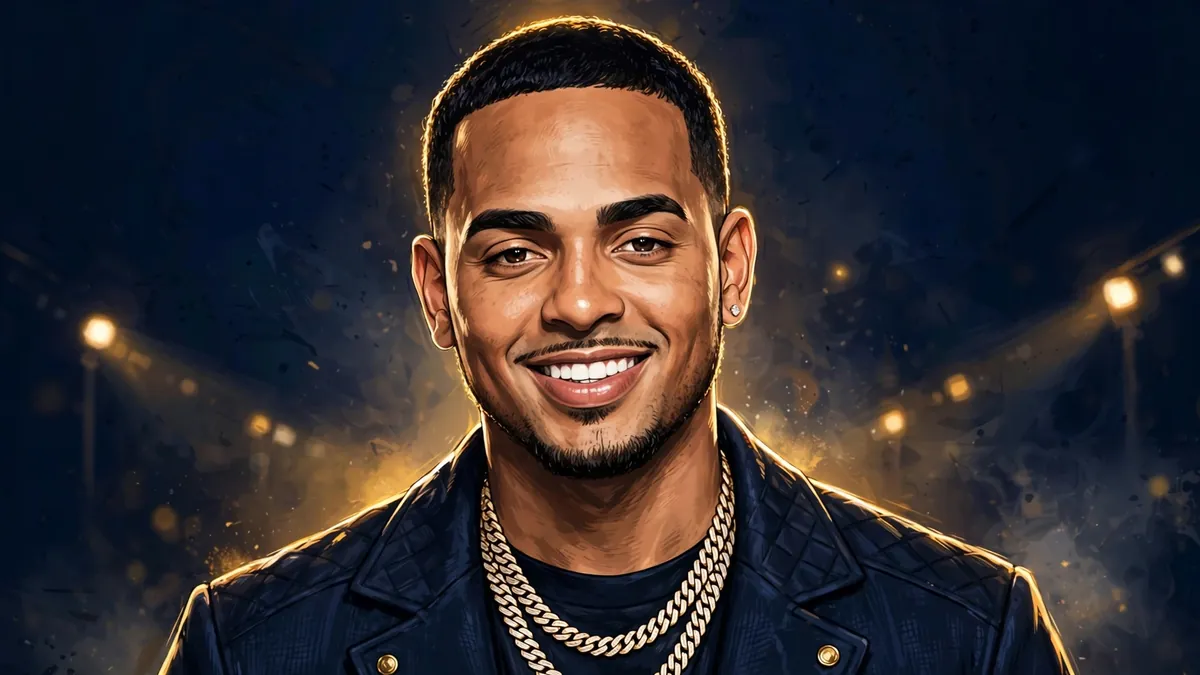
Early Life and Family in San Juan
Juan Carlos Ozuna Rosado was born on March 13, 1992, in San Juan, Puerto Rico, to a Dominican father and a Puerto Rican mother. He has described himself as a “typical boricua with Dominican blood,” and that dual heritage runs through his music — the Puerto Rican reggaeton core, the Dominican dembow and bachata colour around its edges.
His childhood was marked early by loss. His father, a Dominican dancer, was killed when Ozuna was only three years old. His mother was left to raise the family on her own, and Ozuna was brought up mainly by his paternal grandmother. Money was tight. In the opening track of his debut album Odisea, he raps about growing up poor, and that detail has stayed central to how he tells his own story: not as a hardship badge, but as the reason his songs lean positive. He writes uplifting music about working toward your dreams, and he has said he avoids profanity in his lyrics out of respect for his daughter.
The household was full of music. Salsa, bachata, and reggaeton were the sounds of San Juan in the 1990s and early 2000s, and Ozuna absorbed all of them. By 12 he had decided he wanted to be a singer — not a vague childhood dream, but a plan he started working on. He began writing songs as a teenager, and he spent time in New York City as well as Puerto Rico while he was finding his footing, a back-and-forth that later showed up in his ease with both Spanish-language urbano and English-language pop collaborations.
What is easy to miss about Ozuna’s early life is how long the apprenticeship lasted. He did not arrive as a teenage prodigy. He spent his late teens and early twenties singing wherever he could, learning how a room responds to a voice, and building the melodic, almost sung-rap delivery that would later set him apart from the harder-edged reggaeton of his peers. His tenor voice — smooth where many of his contemporaries were percussive — became his signature, and it was trained in small rooms, not studios.
How Ozuna Got Started in Music
Ozuna made his musical debut in 2012 with the song “Imaginando,” which drew the attention of people inside the Puerto Rican music scene. He was discovered by producer Fernando “Damian” Acevedo of Element Music and Damian Music in Santurce’s La Placita district, where he made his first recordings. Acevedo also gave him the advice that shaped his career: use your last name as your artist name. Juan Carlos Ozuna Rosado became simply Ozuna.
The early years were slow. He performed at a local bar called El Corozal in San Juan, building experience in front of live audiences one night at a time, and he released a run of singles that circulated online without breaking through nationally. In 2014 he signed a record contract and began posting singles online more systematically, but the breakthrough was still two years away.
It arrived in 2016 with “La Ocasión,” a collaboration with DJ Luian, Mambo Kingz, De La Ghetto, Arcángel, and Anuel AA that peaked in the Top 30 of Billboard’s Hot Latin Songs chart. The song did two things at once: it put Ozuna’s melodic hook-writing in front of a mass audience, and it placed him inside the network of artists — Anuel AA, Arcángel, De La Ghetto — who were rebuilding Latin trap and reggaeton for a streaming generation. A string of high-profile collaborations followed through 2016 and 2017, each one raising his profile a notch, and by the time he signed with Sony Music Latin in 2017, the industry already knew his name. Sony funded the recording of his debut album, and the deal — signed through VP Entertainment and Dímelo Vi president Vicente Saavedra in June 2017 — gave him the distribution muscle to turn a Puerto Rican buzz into a continental one.
The slow climb matters. Ozuna spent four years between his 2012 debut and his 2016 breakthrough singing in bars and releasing singles that went nowhere nationally. When Odisea landed in 2017, it sounded fully formed because it was — the voice, the melodies, and the songwriting had been worked out in public, in small rooms, long before the charts noticed.
Breakthrough and the Odisea Era
Odisea, released on August 11, 2017, is the album that made Ozuna a star. It debuted at number one on Billboard’s Top Latin Albums chart and stayed there — spending 46 weeks at the top, a run that earned him a Guinness World Record for the longest reign at number one on that chart by a male solo artist. The album featured guest appearances from De La Ghetto, Anuel AA, J Balvin, and others, and its singles — “Dile Que Tu Me Quieres,” “Tu Foto,” “Se Preparó,” and “Síguelo Bailando” — became staples of Latin radio and streaming playlists alike.
What made Odisea land so hard was its balance. The production was pure urbano — dembow rhythms, trap hi-hats, glossy synths — but the songwriting was romantic and melodic in a way that reached listeners who had never bought a reggaeton record. Ozuna sang about love, longing, and loyalty rather than the street-hardened themes that dominated much of the genre, and his tenor carried the melodies cleanly. The album worked as a pop record and a reggaeton record at the same time, which is why it travelled so far beyond Puerto Rico.
The numbers followed. By the end of 2017 Ozuna was one of the most streamed Latin artists in the world, and the industry awards followed in 2018: he won Top Latin Artist and Top Latin Album (for Odisea) at the Billboard Music Awards, and Artist of the Year at the Billboard Latin Music Awards. He also picked up a Latin Grammy nomination for Odisea as Best Urban Music Album. For a debut album from a singer who had been playing a San Juan bar five years earlier, it was a remarkable first act — and it set the pattern for everything that came after: big melodic hooks, star collaborations, and albums built to dominate the Latin charts.
Aura, Taki Taki, and Global Stardom
If Odisea made Ozuna a Latin star, Aura made him a global one. Released on August 24, 2018, his second studio album debuted at number seven on the US Billboard 200 — a rare feat for a Spanish-language album at the time — and again debuted at number one on the Top Latin Albums chart. Five of his studio albums have now topped that chart, but Aura was the one that proved his reach went past the Latin market.
The engine of that reach was “Taki Taki,” his 2018 collaboration with DJ Snake, Cardi B, and Selena Gomez. The track was certified quadruple platinum by the RIAA and became one of the defining pop-reggaeton crossovers of the decade, putting Ozuna’s voice on radio in countries where Spanish-language music had rarely charted. Around it, Aura stacked hits of its own: “Única,” “Vaina Loca” with Manuel Turizo, and “Me Dijeron” kept him at the top of the Latin charts through 2018 and into 2019.
2018 was also the year Ozuna became unavoidable as a featured artist. He appeared on the remix of “Te Boté” alongside Nicky Jam and Bad Bunny, a record that dominated Latin streaming through the summer, and on “El Farsante” with Romeo Santos. He recorded “Imposible” with Luis Fonsi, the man behind the biggest Latin crossover of the decade, and kept a pace of collaborations that made him the most in-demand hook singer in urbano. By February 1, 2019, he held the record for the most one-billion-view videos on YouTube of any artist — a measure of just how completely his music had colonised the platform where Latin music lives.

The recognition piled up in 2019. He won Top Latin Artist and Top Latin Album (for Aura) again at the Billboard Music Awards, took Artist of the Year at the Billboard Latin Music Awards, and was named to Time’s annual list of the 100 most influential people in the world — the kind of honour that signals an artist has crossed from music fame into cultural significance. He also won two Latin Grammy Awards in 2020, both for “Yo x Ti, Tu x Mi,” his collaboration with Rosalía: Best Urban Fusion/Performance and Best Urban Song.
Nibiru, ENOC, and the Albums That Followed
Ozuna’s third studio album, Nibiru, arrived on November 29, 2019 — an 18-track set he described as urbano rather than straight reggaeton, named for a pseudoscientific planet, and loaded with collaborations that showed his range: Diddy, DJ Snake, Swae Lee, and Snoop Dogg all appeared. It became his third straight number-one debut on the Top Latin Albums chart, and singles like “Baila Baila Baila” kept his chart run going into 2020.
His fourth album, ENOC, followed in September 2020, in the middle of the pandemic year that shut down touring for almost every artist on the planet. The album answered with collaborations rather than concerts: Daddy Yankee, J Balvin, Camilo, Nicky Jam, Wisin, Karol G, and Myke Towers all featured, and the Karol G remix of “Caramelo” and “Despeinada” with Camilo became two of the year’s biggest Latin songs. ENOC topped the Top Latin Albums chart as well, extending a run of chart-topping albums that few Latin artists have matched.
The pace did not slow after that. In January 2021 he released Los Dioses, a joint album with Anuel AA — the two had been linked since the “La Ocasión” days, and the record formalised one of urbano’s most productive partnerships. OzuTochi followed on October 7, 2022, an album he said took two years to prepare, whittled down from 65 to 75 recorded songs to a final 18. He surprised fans again with Cosmo in late 2023, and in 2025 he teamed with Colombian singer Beéle for the joint album Stendhal.
One of the most visible moments of this period had nothing to do with an album. In August 2022, Ozuna released “Arhbo” with Congolese-French rapper GIMS and producer RedOne as part of the official soundtrack of the FIFA World Cup Qatar 2022, and on December 18, 2022, he performed it at the tournament’s closing ceremony — a stage watched by hundreds of millions of people, and a long way from El Corozal.
| Album | Year | Notes |
|---|---|---|
| Odisea | 2017 | Debut; 46 weeks at No. 1 on Top Latin Albums; Latin Grammy nominee |
| Aura | 2018 | No. 7 on the Billboard 200; “Taki Taki” certified 4× platinum (RIAA) |
| Nibiru | 2019 | 18 tracks; collaborations with Diddy, DJ Snake, Swae Lee, Snoop Dogg |
| ENOC | 2020 | Features Daddy Yankee, J Balvin, Karol G, Camilo, Nicky Jam, Wisin |
| Los Dioses (with Anuel AA) | 2021 | Joint album with his longtime collaborator Anuel AA |
| OzuTochi | 2022 | 18 songs chosen from 65–75 recorded; “Arhbo” FIFA World Cup year |
| Cosmo | 2023 | Surprise release |
| Stendhal (with Beéle) | 2025 | Joint album with Colombian singer Beéle |
Ozuna’s Biggest Songs and Collaborations
Ozuna’s catalogue is built on two pillars: his own hit singles and a near-unmatched run as a collaborator. Few artists in Latin music have been as generous with features, and that generosity became a business strategy — every collaboration put his voice in front of another star’s audience, and the streaming numbers compounded.
“La Ocasión” (2016) was the breakthrough, the posse cut that introduced his melodic style to the wider urbano audience. “Dile Que Tu Me Quieres” and “Se Preparó” carried Odisea through 2017. “Taki Taki” (2018) with DJ Snake, Cardi B, and Selena Gomez was the global crossover, certified quadruple platinum by the RIAA. The “Te Boté” remix (2018) with Nicky Jam and Bad Bunny was one of the biggest Latin songs of its year, and “Criminal” with Natti Natasha became a streaming monster in its own right. “Caramelo” (2020), remixed with Karol G, and “Despeinada” with Camilo anchored the ENOC era, while “Arhbo” (2022) with GIMS put him on the World Cup stage.
His collaborator list reads like a map of Latin pop: Daddy Yankee’s biography overlaps with Ozuna’s at several points, including shared stages and the ENOC sessions, and J Balvin’s biography runs alongside his through the late 2010s, when the two Colombians-and-Puerto-Ricans axis defined the sound of global reggaeton. Karol G, whose Karol G biography traces her own rise from Medellín to stadiums, teamed with him on the “Caramelo” remix and the ENOC sessions. Add Rosalía (“Yo x Ti, Tu x Mi,” a two-time Latin Grammy winner), Anuel AA (a joint album, Los Dioses), Wisin, Nicky Jam, Manuel Turizo, Camilo, and Myke Towers, and the picture is of an artist who treated collaboration as his main growth engine — and it worked. Around 15 million records sold, and a YouTube record for billion-view videos, is the receipt.
His style is the other half of the story. Ozuna’s music is rooted in reggaeton and Latin trap, but he folds in pop, bachata, salsa, R&B, dancehall, and electronic influences, and his smooth tenor sits on top of beats that other singers attack. That melodic softness is what let his songs cross into pop radio and film soundtracks, and it is also what made him such a useful collaborator: his voice lifts a chorus without fighting the lead artist for space.
Acting Career: From Que León to Fast and Furious
Ozuna made his acting debut in the Dominican comedy film Que León (2018), taking the lead role in a film that became a box-office hit in the Caribbean. It was a natural move — his music videos had always been cinematic, and his screen presence translated. Bigger Hollywood work followed: he appeared in F9 (2021), the ninth film in the Fast & Furious franchise, and in the live-action Tom & Jerry film the same year.
Acting has stayed a side pursuit rather than a second career. The film roles add to his income and his visibility outside music, and they fit the pattern of his brand: a Latin star who can move between a San Juan stage, a FIFA closing ceremony, and a Hollywood set without changing who he is on screen. Whether he pursues bigger roles next is an open question — his 2022 interviews suggested more film work was on his mind — but music remains the centre of the business.
How Ozuna Makes His Money
Ozuna’s fortune comes from four main streams, and understanding them explains why his net worth sits where it does — and why estimates differ by as much as $9 million between outlets.
Streaming and recorded music is the foundation. With around 15 million records sold and billions of streams across Spotify, YouTube, and Apple Music, his catalogue earns steadily even in years without a new album. His five chart-topping albums on Billboard’s Top Latin Albums chart, plus a run of singles that each passed a billion YouTube views, mean the back catalogue keeps paying. Streaming pays fractions of a cent per play, so the money here is a volume game — and Ozuna’s volume is enormous.
Touring and live shows is the second pillar, and the most lucrative per night. Arena and festival dates across Latin America, the United States, and Europe, plus the big one-off stages like the FIFA World Cup closing ceremony, pay far more per appearance than streaming ever will. The pandemic year of 2020 cut this stream off almost entirely, which is one reason his wealth grew more slowly that year than the album numbers alone would suggest.
Collaborations and features form a third stream that most net-worth roundups undercount. Ozuna is one of the most featured voices in Latin music, and feature fees, shared royalties, and the audience growth each collaboration brings all feed the bottom line. “Taki Taki” alone, certified quadruple platinum by the RIAA, generated royalties across four major artists’ fanbases.
Acting, endorsements, and business round out the picture — film roles in Que León, F9, and Tom & Jerry, brand work, and the ventures covered in the next section. Readers who want the headline number in one place can find it in our companion piece on Ozuna’s net worth, which breaks down the $15M–$24M estimate and the sources behind it.
Why the range is wide. Celebrity Net Worth lists Ozuna at $24 million (updated August 2026). Famous People Today puts him at $20 million. TheCityCeleb and other biography outlets land at $15 million, and Popnable’s 2026 estimate sits at $17.8 million. None of these outlets sees his private accounts — they are working from public records, reported deals, and streaming data — so the honest figure is a range, $15M–$24M, with $24 million as the best-sourced top end.
Business Ventures: Aura Music, Vocation, and Basketball
Ozuna has moved steadily from artist to owner, and the business portfolio is now a real part of his wealth — and of his biography. The three moves that matter most:
Aura Music, his own record label, gives him a stake in other artists’ careers as well as his own releases. Running a label means owning masters and taking a share of the next generation’s streaming income, not just his own — the same playbook other Latin stars have used to turn a hit-making career into a durable business.
Vocation, the luxury champagne brand, became his in 2023, when he completed the purchase of the label. Champagne is a classic celebrity-business move — high margins, strong branding, a natural fit for an artist whose image is built on celebration — and owning the brand outright, rather than lending his name to it, is the difference between an endorsement fee and an asset.

Osos de Manatí, the Manatí Bears basketball team in Puerto Rico’s Baloncesto Superior Nacional league, is the most personal of his investments. Ozuna bought the franchise and became its owner, tying his name to professional sport in his home island — a move that carries cultural weight in Puerto Rico far beyond the balance sheet, and one that also connects to his love of the game (he has said he would be rooting for Lionel Messi’s Argentina at the 2022 World Cup, and his “Arhbo” performance tied music to football on the biggest stage of all).
Together, the label, the champagne brand, and the basketball team show the same instinct: Ozuna invests in things he understands and can promote with his own audience. None of these ventures has a publicly reported valuation, so they are not counted as separate line items in his net-worth estimate — but they are the reason the top-end $24 million figure is plausible, and the reason his wealth is likely to keep growing even if his release schedule slows.
Real Estate and Cars
The best-documented piece of Ozuna’s property portfolio is his Miami home. In August 2020 he paid $5.475 million for a mansion in Miami’s Coconut Grove neighbourhood, according to Celebrity Net Worth — a five-bedroom, six-bathroom property that fits the pattern of Latin stars basing themselves in South Florida, close to the labels, studios, and collaborators that run the industry. Miami has been his professional base for years, and the Coconut Grove purchase put that down in bricks and mortar.
Beyond that one purchase, public reporting on his property and cars is thin, and this biography will not fill the gap with guesses. He is known to favour luxury vehicles and has appeared with high-end cars in videos and on social media, but no reliable outlet has published a verified inventory of his garage, and no other property purchase has been documented in the public record with the same confidence as the Coconut Grove house. What can be said is that the Miami mansion, at $5.475 million, represents roughly a quarter of his estimated net worth at the top end of the range — a significant but not reckless share for a star of his standing.
Net Worth Growth Over the Years
Ozuna’s wealth was not built in a single year. It tracks his career in distinct phases, each one adding a new income stream on top of the last:
| Phase | What changed |
|---|---|
| 2012–2015: The grind | Debut single “Imaginando,” first recordings, bar gigs at El Corozal, early singles online. Income modest; reputation building. |
| 2016: Breakthrough | “La Ocasión” hits the Hot Latin Songs Top 30; collaborations with Anuel AA, Arcángel, and De La Ghetto raise his fee and profile. |
| 2017: Odisea | Sony Music Latin deal; debut album tops the Latin chart for 46 weeks; first Billboard Music Awards wins follow in 2018. |
| 2018–2019: Global stardom | Aura debuts at No. 7 on the Billboard 200; “Taki Taki” goes 4× platinum; most billion-view YouTube videos of any artist (Feb 2019); Time 100. |
| 2020–2021: Pandemic pivot | Touring stops, but ENOC and Los Dioses keep streaming income high; Miami mansion bought for $5.475 million (Aug 2020); two Latin Grammys for “Yo x Ti, Tu x Mi.” |
| 2022–2023: Expansion | OzuTochi; “Arhbo” and the FIFA World Cup closing ceremony; Cosmo; purchase of Vocation champagne and the Osos de Manatí basketball team. |
| 2024–2026: Consolidation | Catalogue income, touring, and business ventures compound; joint album Stendhal with Beéle (2025); net worth estimates settle at $15M–$24M. |
The shape of that timeline is the shape of most modern music fortunes: a slow start, a steep climb when the hits land, a plateau during the pandemic, then growth driven less by new singles and more by ownership — a label, a brand, a team, a catalogue that earns while he sleeps.
Awards and Records
Ozuna’s trophy count is one of the strongest in Latin music. Across his career he has won 82 awards from 238 nominations, according to the tally maintained on his awards record — a hit rate that reflects both how often he is nominated and how often he wins.
| Award body | Wins | Notes |
|---|---|---|
| Latin Grammy Awards | 2 | Both for “Yo x Ti, Tu x Mi” with Rosalía (2020): Best Urban Fusion/Performance and Best Urban Song |
| Billboard Music Awards | 5 | Includes Top Latin Artist (2018, 2019) and Top Latin Album for Odisea and Aura |
| Billboard Latin Music Awards | 12 | Includes Artist of the Year (2018, 2019) |
| Guinness World Records | 4 | Most billion-view YouTube videos; longest Top Latin Albums reign (Odisea); most Billboard Latin Music Award nominations (23); most wins by a single artist (11) |
| BMI Latin Awards | 28 | Songwriting honours across his catalogue |
| Latin American Music Awards | 8 | Multiple wins across categories |
| Premios Lo Nuestro | 8 | Multiple wins across categories |
| Premios Juventud | 4 | Youth-voted honours |
Beyond the trophies, the records tell their own story. Four Guinness World Records before the age of 27, a Time 100 place in 2019, and five studio albums topping Billboard’s Top Latin Albums chart add up to a career that the industry has measured, repeatedly, as historically significant — not just popular.
Personal Life: Partner, Children, and Faith
Ozuna keeps his private life far quieter than his public one, and the facts that are known are simple. His longtime partner is Taina Marie Meléndez. The two got engaged in 2020 after nearly eight years together, though it is not clear from public reporting whether they are legally married. They have two children, Sofía and Jacob, and Ozuna has spoken about his daughter as the reason he keeps profanity out of his lyrics — a choice that also shaped his public image as the clean-cut romantic of reggaeton.
Family runs through his music and his decisions. He was raised by his grandmother after his father’s death, and he has stayed close to Puerto Rico even as his career went global — buying a basketball team on the island, recording there, and returning to it between tours. He does not parade his family on social media the way some stars do; the children appear rarely, and his partner stays largely out of the spotlight.
His age is a frequent search, and for readers tracking it year by year, our sister site covers how old Ozuna is today in detail. He turned 34 on March 13, 2026, and he has spent more than half his life — since the age of 12 — working toward the career he now has.
Controversies and Legal Issues
Ozuna’s public record includes one serious episode, and it deserves a straight telling. In January 2019, an explicit video of Ozuna — filmed when he was a minor — was circulated online, and he issued a public apology, saying he had been the victim of extortion over the recording. Puerto Rican authorities investigated, and the trap artist Kevin Fret, who had reportedly threatened to release the video, was murdered in San Juan on January 10, 2019. Ozuna was questioned by police as a witness in that investigation; he was not charged, and no link between him and the killing was established. The episode was widely covered at the time, and Ozuna has since spoken about it as a mistake from his youth that was used against him.
Beyond that episode, Ozuna’s record is notably clean for a star of his size. He has avoided the feuds and public disputes that fill the gossip columns around many of his peers, and his controversies since 2019 have been limited to the ordinary churn of celebrity life — dating rumours, social-media speculation, and the occasional misread quote. That restraint is part of his brand: the romantic hitmaker rather than the tabloid fixture.
Ozuna Compared With His Reggaeton Peers
Ozuna’s $15M–$24M range puts him in the upper tier of reggaeton wealth, but not at the very top — and the comparison shows why career shape matters as much as fame. The figures below are Celebrity Net Worth estimates, the same outlet that anchors Ozuna’s $24 million, so the comparison is like-for-like.
| Artist | Celebrity Net Worth estimate | What sets the fortune apart |
|---|---|---|
| Ozuna | $24 million | 15 million records; label, champagne brand, and basketball team ownership |
| Daddy Yankee | $40 million | Two-decade career; “Despacito” and “Gasolina” royalties; the genre’s elder statesman |
| J Balvin | $30 million | Global pop crossovers, fashion and brand deals, long touring career |
| Karol G | $25 million | Stadium touring, “Mañana Será Bonito” era, brand partnerships |
| Luis Fonsi | $20 million | “Despacito” — the biggest Latin crossover of all time — plus a long catalogue |
Readers can explore the fuller stories behind these names on this site: Daddy Yankee’s biography covers the two-decade climb that built the genre, and J Balvin’s biography traces the Colombian star’s parallel path to global pop. Ozuna’s edge against that field is his age — at 34, with a catalogue that still earns and businesses that are still young, his fortune has more runway than most of the names above it.
The other lesson of the table is that net worth in this genre tracks ownership as much as streams. The artists at the top did not just sing hits; they bought teams, launched brands, and kept their masters. Ozuna is following that same path, a decade behind Daddy Yankee and a step behind J Balvin — which is why the $24 million figure reads less like a ceiling than a waypoint.
Frequently Asked Questions
What is Ozuna’s real name?
Ozuna’s real name is Juan Carlos Ozuna Rosado. He was born on March 13, 1992, in San Juan, Puerto Rico, and took his stage name from his surname on the advice of producer Fernando “Damian” Acevedo, who discovered him.
How old is Ozuna in 2026?
Ozuna is 34 years old in 2026. He was born on March 13, 1992, so he turned 34 on March 13, 2026.
What is Ozuna’s net worth in 2026?
Ozuna’s net worth is estimated at $15 million to $24 million as of November 2026. Celebrity Net Worth, which updated his profile on August 3, 2026, lists $24 million, while Famous People Today puts him at $20 million and other outlets at $15 million to $17.8 million. The range reflects different methods, not a disagreement about the shape of his career.
Where is Ozuna from?
Ozuna is from San Juan, Puerto Rico, where he was born and raised. His mother is Puerto Rican and his father was Dominican, and he describes himself as a “typical boricua with Dominican blood.” He was raised mainly by his paternal grandmother after his father was killed when Ozuna was three.
What are Ozuna’s biggest songs?
Ozuna’s biggest songs include “Taki Taki” with DJ Snake, Cardi B, and Selena Gomez (certified quadruple platinum by the RIAA), “La Ocasión,” “Dile Que Tu Me Quieres,” “Se Preparó,” the “Te Boté” remix with Nicky Jam and Bad Bunny, “Criminal” with Natti Natasha, “Caramelo” with Karol G, and “Arhbo” with GIMS, the official FIFA World Cup Qatar 2022 song he performed at the closing ceremony.
How many albums does Ozuna have?
Ozuna has released six solo studio albums — Odisea (2017), Aura (2018), Nibiru (2019), ENOC (2020), OzuTochi (2022), and Cosmo (2023) — plus two collaborative albums, Los Dioses with Anuel AA (2021) and Stendhal with Beéle (2025). Five of his studio albums have topped Billboard’s Top Latin Albums chart.
Who is Ozuna’s wife or partner?
Ozuna’s longtime partner is Taina Marie Meléndez. They got engaged in 2020 after nearly eight years together, though public reporting does not confirm whether they are legally married. They have two children together, Sofía and Jacob, and Ozuna keeps his family life largely private.
What awards has Ozuna won?
Ozuna has won 82 awards from 238 nominations, including two Latin Grammy Awards (both for “Yo x Ti, Tu x Mi” with Rosalía), five Billboard Music Awards, twelve Billboard Latin Music Awards, and four Guinness World Records. He was also named to Time’s 100 most influential people list in 2019.
Final Thoughts
Ozuna’s biography is the story of a singer who took the long road and then ran the last mile at full speed. Four years of bar gigs and forgotten singles, then a breakthrough at 24, then five chart-topping albums, a World Cup stage, two Latin Grammys, and a business portfolio that now includes a record label, a champagne brand, and a basketball team. The $15M–$24M net worth is the headline, but the more useful number is 15 million records sold — the proof that the audience, not the hype, built the fortune.
At 34, with a catalogue that earns every day and businesses still in their early years, Ozuna’s story is still being written. The next chapter is likely to be about ownership more than hits — and if the last decade is any guide, he will take the same patient approach to it that carried him from El Corozal to the World Cup final. For more celebrity life stories in the same style, browse our biography archive.
Sources and Reporting
How we estimated: Ozuna’s net worth is an estimate, not a disclosed figure. We anchored it on Celebrity Net Worth ($24 million, profile updated August 3, 2026) and checked it against Famous People Today ($20 million), TheCityCeleb ($15 million), and Popnable ($17.8 million). Where sources disagreed, we published the full $15M–$24M range rather than picking one number. Career facts — album dates, chart runs, awards, and the 15-million-records figure — come from Wikipedia, AllMusic, Billboard reporting, and Consequence. Business details (Vocation champagne, Osos de Manatí) come from biography outlets reporting the purchases; none of those ventures has a publicly reported valuation, so they are described, not priced. Estimates may differ from private reality, and figures will be updated as new reporting lands.
Sources consulted: Celebrity Net Worth, Wikipedia, AllMusic, Billboard, Consequence, Famous People Today, TheCityCeleb, Guinness World Records.