Last updated: November 7, 2026 · By Celebamerica Editorial Staff
Justin Jefferson is 6 feet 1 inch tall (1.85 m). That is the listed height carried by the Minnesota Vikings, the NFL, and Wikipedia as of November 2026. Measured barefoot at the 2020 NFL Scouting Combine, he came in a touch taller — 6 feet 1¼ inches (1.86 m) — which is the number scouts still quote when they talk about his frame. Either way, the answer is the same in plain terms: six-one, a shade over 185 centimetres, and right in the sweet spot for a modern NFL wide receiver.
Height alone does not explain why Jefferson has become the most productive young receiver in football, but it is a real part of the package. A 6-foot-6 wingspan, 33-inch arms, and a 37.5-inch vertical jump let him play taller than his listed height, and the tape backs that up: he owns the most receiving yards through a player’s first five seasons in NFL history, and in 2022 he became the youngest player ever to lead the league in both receptions and receiving yards in the same season. This page settles the height question with the official numbers, explains why a few sites list him at 6 feet 2 inches, compares him with the other star receivers in the league, and rounds out the full picture — his LSU rise, his Vikings career, his record contract, and his life off the field.
Quick Facts
| Full Name | Justin Jamal Jefferson |
|---|---|
| Date of Birth | June 16, 1999 (age 27 in 2026) |
| Birthplace | St. Rose, Louisiana, USA |
| Listed Height | 6 ft 1 in (1.85 m) — NFL Combine measurement: 6 ft 1¼ in (1.86 m) |
| Weight | 195 lb listed (88 kg); 202 lb (92 kg) at the 2020 NFL Combine |
| Position | Wide receiver, Minnesota Vikings (No. 18) |
| College | LSU Tigers (2017–2019); 2019 national champion |
| NFL Draft | 2020, 1st round, 22nd overall pick (Minnesota Vikings) |
| Career Stats (through Week 8, 2026) | 607 receptions, 8,815 receiving yards, 46 touchdowns |
| Estimated Net Worth (2026) | $40–50 million, anchored at $50 million (Celebrity Net Worth) |
| Contract | Four-year, $140 million extension (June 2024), $35 million average per year |
| Key Honours | NFL Offensive Player of the Year (2022); four Pro Bowls and four All-Pro selections in his first five seasons |
Table of Contents
- Quick Facts
- How Tall Is Justin Jefferson?
- The Official Numbers: Combine Measurements Explained
- Justin Jefferson’s Height Compared to Other NFL Wide Receivers
- How His Height Shapes His Game
- Early Life and Background
- College Career at LSU
- NFL Career and Rise With the Vikings
- The Money: Contract, Salary and Endorsements
- Net Worth in 2026
- Assets and Lifestyle
- Personal Life
- Height in Feet, Inches and Centimetres
- Frequently Asked Questions
- Final Thoughts
- Sources & Reporting
How Tall Is Justin Jefferson?
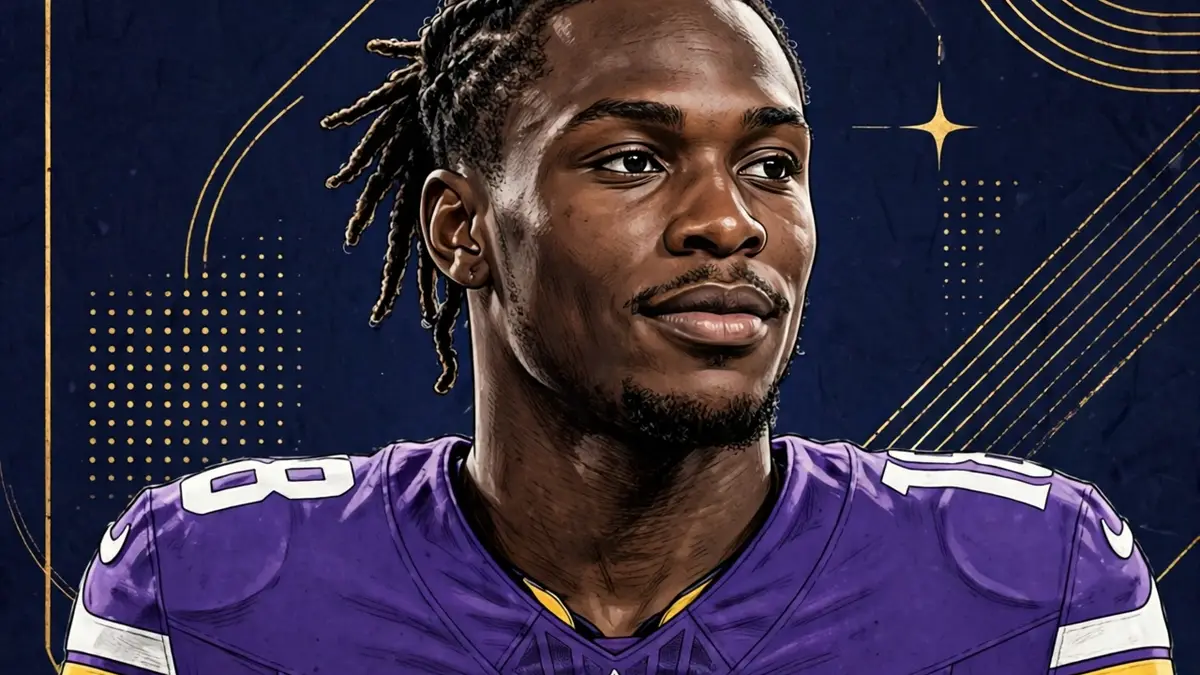
Justin Jefferson stands 6 feet 1 inch tall. That figure — 1.85 metres — is the one the Vikings list on their roster, the one the NFL carries on his player page, and the one Wikipedia records in his infobox. It has been steady since he entered the league in 2020, and nothing in six NFL seasons has given anyone a reason to revise it.
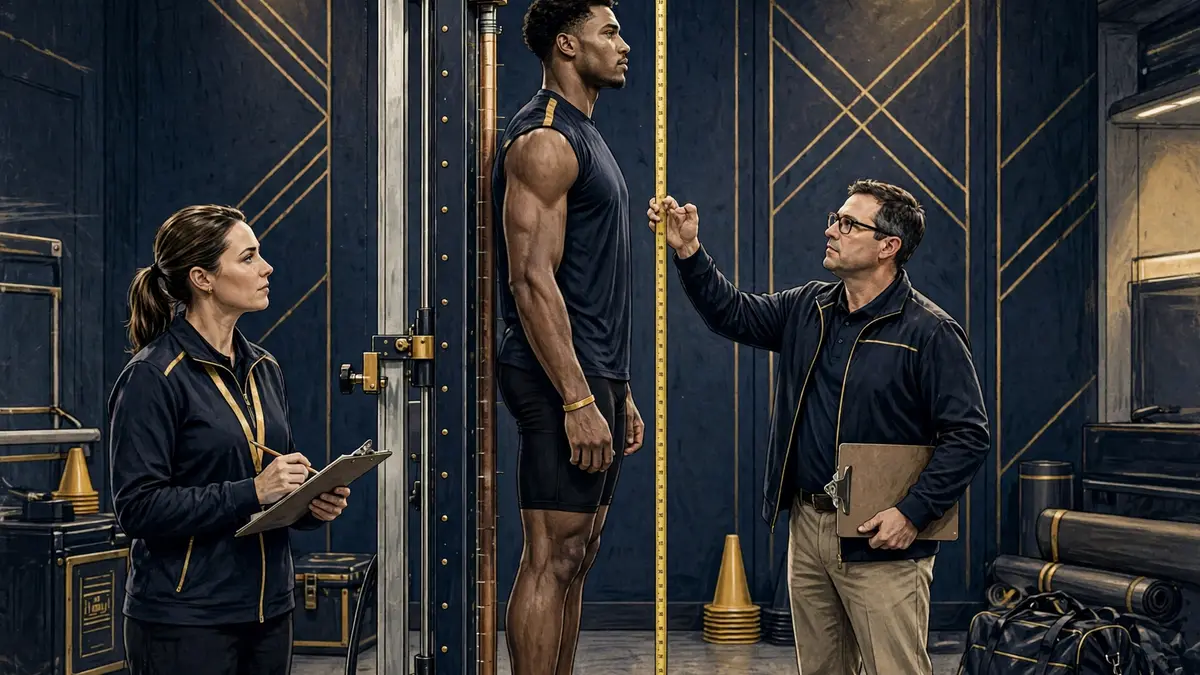
The small wrinkle is the quarter-inch. When Jefferson was measured at the 2020 NFL Scouting Combine in Indianapolis, the official reading was 6 feet 1¼ inches (1.86 m). Combine heights are taken barefoot, in the morning, with laser or stadiometer equipment, and they are the most exact numbers in football. Teams round them down to the nearest inch for roster listings, which is how 6-foot-1¼ becomes the familiar 6-foot-1.
A handful of databases list him at 6 feet 2 inches instead. Pro Football Archives, for example, carries 6-2 in its player record. That is almost certainly a rounding-up from an old college listing rather than a fresh measurement: LSU’s roster pages, like many college programmes, tended to round players up, and a few aggregator sites copied those numbers and never corrected them. The weight of the evidence — the combine measurement, the Vikings roster, the NFL, Pro Football Reference’s combine data, and Over The Cap — sits at 6-foot-1. For this article, 6-foot-1 is the headline figure and 6-foot-1¼ is the precise combine figure. The 6-foot-2 listings are noted here so readers who spotted them elsewhere are not left wondering, but they are not the official number.
For fans who think in metric, 6 feet 1 inch converts to 185.4 centimetres, usually written as 185 cm. The combine figure of 6 feet 1¼ inches converts to 186 cm. In everyday conversation, “six-one” is all anyone needs.
The short answer: Justin Jefferson is 6 ft 1 in (1.85 m) tall. His official NFL Combine measurement was 6 ft 1¼ in (1.86 m), taken barefoot in February 2020.
The Official Numbers: Combine Measurements Explained
The NFL Scouting Combine is where a prospect’s body becomes a set of numbers, and Jefferson’s numbers from February 2020 told a story that changed how scouts saw him. He arrived in Indianapolis carrying a reputation as a polished route-runner from LSU’s national championship team, but with questions about whether he had the raw athleticism to separate from NFL cornerbacks. The testing answered that in a single morning.
| Measurement | Justin Jefferson (2020 NFL Combine) |
|---|---|
| Height | 6 ft 1¼ in (1.86 m) |
| Weight | 202 lb (92 kg) |
| Arm length | 33 in (0.84 m) |
| Hand span | 9⅛ in (0.23 m) |
| Wingspan | 6 ft 6 in (1.98 m) |
| 40-yard dash | 4.43 seconds |
| 10-yard split | 1.54 seconds |
| 20-yard split | 2.61 seconds |
| Vertical jump | 37.5 in (0.95 m) |
| Broad jump | 10 ft 6 in (3.20 m) |
| Wonderlic | 19 |
The 40-yard dash was the headline. Jefferson ran 4.43 seconds — far quicker than the 4.6-second range many draft analysts had pencilled in for him — and the time, reported at the time by 247Sports and others covering the combine, pushed him firmly into the first round. The 1.54-second 10-yard split mattered just as much to scouts, because it measures the burst off the line that a receiver needs to win in the first five yards. His 37.5-inch vertical and 10-foot-6 broad jump showed lower-body explosion, and the 33-inch arms and 6-foot-6 wingspan explained what the tape already showed: a catch radius far bigger than his listed height suggests.
One detail worth understanding is how combine heights are taken. Players are measured without shoes, standing flat against a stadiometer, usually early in the morning when the spine is at its longest after a night lying down. That is why combine figures often run a fraction taller than a player’s listed height, and why the quarter-inch gap between Jefferson’s 6-foot-1¼ combine reading and his 6-foot-1 roster listing is normal, not a contradiction. The combine figure is the precise measurement; the roster figure is the rounded one.
Weight is the number that has moved most since the combine. Jefferson weighed 202 pounds in Indianapolis. His current listed playing weight is 195 pounds, per Wikipedia and the Vikings, while Over The Cap carries 202. Players’ weights shift across a season and across a career — training cycles, conditioning programmes, and the simple fact that a 27-year-old’s body is not a 20-year-old’s body all play a part. The honest range is 195 to 202 pounds, and both numbers appear in reputable sources.
Justin Jefferson’s Height Compared to Other NFL Wide Receivers
Six-foot-one sits in a useful place on the wide receiver spectrum. It is tall enough to win contested balls against most cornerbacks, who typically stand between 5-foot-10 and 6-foot-1, yet short enough to keep the quick feet and low centre of gravity that make a receiver hard to press at the line. The average NFL wide receiver is listed at roughly 6 feet to 6 feet 1 inch, so Jefferson is right at the position’s middle — and the comparison with his peers shows how little a single inch matters next to skill.
| Receiver | Listed Height | Difference vs Jefferson |
|---|---|---|
| DK Metcalf | 6 ft 4 in | 3 in taller |
| CeeDee Lamb | 6 ft 2 in | 1 in taller |
| A.J. Brown | 6 ft 1 in | Same height |
| Davante Adams | 6 ft 1 in | Same height |
| Justin Jefferson | 6 ft 1 in | — |
| Ja’Marr Chase | 6 ft 0 in | 1 in shorter |
| Tyreek Hill | 5 ft 10 in | 3 in shorter |
The names at the top of that table tell the story. DK Metcalf, at 6-foot-4, is a physical outlier who wins with size and straight-line power. CeeDee Lamb, at 6-foot-2, has an inch on Jefferson. A.J. Brown and Davante Adams are listed at exactly the same height, and both are among the best route-runners of their generation. Ja’Marr Chase — Jefferson’s old LSU teammate and the man who broke his rookie receiving record — is an inch shorter at 6 feet, and Tyreek Hill, one of the most feared receivers of the last decade, is three inches shorter at 5-foot-10. Hill’s career is the clearest proof that height is one variable among many: his speed, not his size, is what defences fear.
What separates Jefferson from the shorter receivers is not the inch or two on a roster page but what his arms do with it. His 6-foot-6 wingspan is five inches longer than his height, which is a big spread for a receiver. Long arms extend a player’s catch radius — the area in which he can reach a ball — and they matter most on the throws that decide games: back-shoulder fades, sideline catches with a toe in bounds, and jump balls in the end zone. Add a 37.5-inch vertical, and Jefferson can reach balls that a cornerback of the same height simply cannot get to. That is why scouts and coaches talk about Jefferson “playing long” — his effective size on a catch is closer to 6-foot-4 than 6-foot-1.
Height also shapes the matchups defences choose. Against a 6-foot-1 receiver with long arms, a 5-foot-10 cornerback is giving up three inches before the ball is even thrown, and a taller cornerback usually gives up speed. Jefferson’s combination — six-one, 4.43 speed, long arms — leaves defensive coordinators without a clean answer, and it is a large part of why he has produced at a historic rate since his rookie year.
How His Height Shapes His Game
Watch Jefferson for a full game and the height story plays out in four places: at the line of scrimmage, at the top of a route, at the catch point, and after the catch.
At the line, six-one with long arms lets him fight through press coverage. Cornerbacks try to jam receivers in the first five yards, and a receiver who can keep his hands free and his chest clean wins that fight. Jefferson’s arm length helps him swat away a jam and get into his route on time, which is one reason he is so hard to slow down even when defences dedicate their best cornerback to him.
At the top of a route, his height and body control turn separation into something a quarterback can trust. Jefferson is famous for the precision of his routes — the sharp breaks, the head fakes, the way he sells a deep route before snapping it off underneath. His size lets him shield the ball from a defender with his body on comeback and curl routes, a skill that favours taller receivers who can put their frame between the ball and the man covering them.
At the catch point is where the measurements pay off most visibly. The 2022 season gave the defining example: a one-handed catch against the Buffalo Bills in November 2022, reaching back over a defender to snatch a fourth-down pass that kept the Vikings alive in a game they went on to win in overtime. The catch became one of the most replayed plays of the season, and it was a wingspan catch — the ball was simply not reachable for a receiver with shorter arms. Jefferson’s highlight reel is full of that kind of play: contested catches on the sideline, high-pointed balls in the end zone, and grabs where his hands are the only part of him a defender can see.
After the catch, his frame helps in a different way. At 195 to 202 pounds he is sturdy enough to break arm tackles and keep his balance through contact, and his long stride eats up ground once he is in the open field. He is not a power back in a receiver’s jersey, but he is not easy to bring down with one arm, and that matters for yards after the catch — the part of a receiver’s game that turns a 12-yard gain into a 40-yard one.

It is worth saying plainly that height is not the reason Jefferson is great. The reasons are his hands, his route-running, his body control, and his feel for space — skills that would make him a star at 5-foot-11 or 6-foot-3. Height is a supporting actor. But it is a useful one, and the combine numbers explain why a player listed at six-one so often looks like the biggest man on the field when the ball is in the air.
Early Life and Background
Justin Jamal Jefferson was born on June 16, 1999, in St. Rose, Louisiana, a small community on the Mississippi River west of New Orleans. He is the youngest of three sons born to John and Elaine Jefferson, and football was the family business in the most literal sense: both of his older brothers played the game, and his father John played college football at Louisiana Tech before a stint in the NFL. Growing up in a house where football was discussed at the dinner table gave Jefferson an education that no coaching clinic could match.
His oldest brother, Jordan Jefferson, was a quarterback at LSU, starting for the Tigers in the early 2010s. His other brother, Rickey Jefferson, played defensive back at LSU. For Justin, that meant the path was visible from childhood: the same high school, the same university, the same game. It also meant the bar was high. He was not the most celebrated Jefferson when he started out — he was the little brother trying to catch up.
Jefferson attended Destrehan High School in Destrehan, Louisiana, where he played wide receiver. The recruiting services were not impressed at first. 247Sports ranked him as a three-star prospect and the 308th-best wide receiver in the country in his class, a ranking that looks almost comical in hindsight. He was not invited to the elite camps, and the big programmes were slow to call. LSU, the school his brothers had attended and the biggest programme in his home state, eventually offered, and he committed. The low ranking stayed with him: it became fuel, and it is still part of his story — the player the experts missed, who turned a three-star rating into the best start to a receiving career in NFL history.
College Career at LSU
Jefferson arrived at LSU in 2017 under head coach Ed Orgeron and spent three seasons in Baton Rouge. His first year was quiet: he appeared in two games and did not record a catch. Plenty of receivers with that kind of start fade into depth-chart obscurity. Jefferson went the other way.
In 2018, his sophomore season, he became LSU’s leading receiver with 54 catches for 875 yards and six touchdowns. His first collegiate touchdown came on a 65-yard reception from Joe Burrow against Ole Miss on September 29, 2018, and he topped 100 yards in a game twice that year — 108 against Georgia and 117 against Arkansas. The production was real, but the team around him was still finding its identity.
Everything changed in 2019. Burrow, in his second year as LSU’s starting quarterback, put together one of the greatest seasons a college quarterback has ever had, and Jefferson was his most reliable target. In the season’s second game, a 45–38 win at Texas, Jefferson caught nine passes for 163 yards and three touchdowns. Against Florida in October he had 10 catches for 123 yards and a touchdown. In the SEC Championship against Georgia he added seven catches for 115 yards and a score. By the time LSU reached the College Football Playoff with an undefeated record, Jefferson was the engine of the most productive passing attack in the country.
The Peach Bowl semi-final against Oklahoma was his signature college game. LSU scored early and often in a 63–28 win, and Jefferson was at the centre of it, finishing the season with 111 catches for 1,540 yards and 18 touchdowns across 15 games. LSU beat Clemson in the national championship game to complete a perfect 15–0 season, and Jefferson, a junior, declared for the NFL Draft. He left Baton Rouge as the fifth-leading receiver in school history with 165 career receptions, and with a national championship ring.
NFL Career and Rise With the Vikings
The Minnesota Vikings selected Jefferson in the first round of the 2020 NFL Draft, 22nd overall. The pick came with the draft capital Minnesota had received in the Stefon Diggs trade, which meant Jefferson arrived with an obvious job to do: replace one of the league’s best receivers. It was a heavy ask for a rookie. He handled it at once.
His rookie season in 2020 produced 88 receptions for 1,400 yards and seven touchdowns — at the time a rookie receiving record, and still one of the great debut seasons any receiver has had. He was named to the Pro Bowl and the All-Pro second team, and he finished second in Offensive Rookie of the Year voting. The 4.43 speed from the combine showed up on Sundays, and so did the hands: he dropped almost nothing.
He kept climbing. In 2021 he caught 108 passes for 1,616 yards and 10 touchdowns. In 2022, his third season, he put together the year that defines him so far: 128 receptions and 1,809 receiving yards, both league-leading totals, with eight touchdowns. At 23 years old he became the youngest player in NFL history to lead the league in both receptions and receiving yards in the same season, and he was named the NFL’s Offensive Player of the Year and a first-team All-Pro. He was also named to his third straight Pro Bowl.
The 2023 season was interrupted by a hamstring injury that cost him seven games — the first real setback of his career — but he still managed 68 catches for 1,074 yards in 10 games, topping 1,000 yards for the fourth straight season. He returned healthy in 2024, the first year of his new contract, and kept producing as the Vikings changed quarterbacks around him.
Through Week 8 of the 2026 season, his career totals stand at 607 receptions, 8,815 receiving yards, and 46 touchdowns, per Wikipedia’s career statistics table. The record that matters most to his legacy is the one he set early: the most receiving yards through a player’s first five seasons in NFL history. He has been named to the Pro Bowl and the All-Pro team in four of his first five seasons, a hit rate that puts him on a Hall of Fame track if he stays healthy. He is also the player who made the “Griddy” — the touchdown dance he popularised — a fixture of football culture, performed by players and fans across the sport.
The Money: Contract, Salary and Endorsements
Jefferson’s money story starts with the rookie deal he signed as the 22nd overall pick in 2020 — a four-year contract worth roughly 13 million dollars in total — and it changed completely in June 2024, when he signed a four-year, 140 million dollar extension with the Vikings. The deal carried an average annual value of 35 million dollars, making him the highest-paid non-quarterback in NFL history at the time of signing, and it included 110 million dollars in guarantees, with 88.743 million dollars fully guaranteed at signing, according to reporting from Celebrity Net Worth and the contract details carried by Spotrac and Over The Cap.
The cash flow of the deal is front-loaded, which is how the big money actually reaches a player. Spotrac lists his career NFL earnings at 83,541,172 dollars through the end of the 2025 season — including a 36,938,000 dollar signing bonus in 2024 and a 30 million dollar option bonus exercised in 2025 — and schedules a further 89.75 million dollars across 2026, 2027 and 2028, starting with 25,750,000 dollars in cash for the 2026 season. His base salary for 2026 is listed at a relatively modest 1,170,000 dollars, but that figure is misleading on its own: most of his pay arrives as bonuses, which is standard for a deal of this size.
Off the field, Jefferson’s endorsement portfolio has grown with his profile. His deals have included Under Armour, Old Spice, Sleep Number, Optimum Nutrition, Oakley and Little Caesars, plus his work with EA Sports — he was the cover athlete for Madden NFL 24, one of the most visible endorsements in American sport. Forbes’ May 2025 accounting put his off-field income at roughly 4 million dollars for the year, against about 68.2 million dollars of on-field income, and some outlets estimate his endorsement earnings as high as 4 to 6 million dollars a year. The exact figures are not public, and this article does not invent them, but the direction is clear: his brand value now runs well beyond his salary.
Readers who want the full money picture — the year-by-year earnings breakdown, the contract structure in detail, and the honest range of net worth estimates — can read our sister site’s deep look at Justin Jefferson’s net worth on GuideNetWorth, which covers the financial side of his career in full.
Net Worth in 2026
Justin Jefferson’s net worth in 2026 is estimated at 40 to 50 million dollars, anchored at 50 million dollars. Celebrity Net Worth, which updated its Jefferson page on October 14, 2026, puts the figure at 50 million dollars. Surprise Sports, updated October 22, 2026, carries the same range of 40 to 50 million dollars, and GuideNetWorth’s October 2026 estimate sits at 35 to 50 million dollars anchored at about 45 million. The honest range, across the named sources, is 40 to 50 million dollars, and this article anchors at the top of it because the most recently updated source — Celebrity Net Worth — lands there.
It is worth understanding why the net worth figure is so much smaller than the 140 million dollar contract. A contract’s headline value is not money in the bank: it is salary and bonuses paid over four years, before taxes, agent fees, and living costs, and much of it is still in the future. Through the end of 2025 Jefferson had actually been paid about 83.5 million dollars in career NFL earnings, per Spotrac, with a further 89.75 million scheduled through 2028. Net worth measures what a person holds now — cash, investments, property, and other assets minus debts — not what they are contracted to earn later. That is why careful outlets put him in the 40-to-50 million range rather than anywhere near 140 million, and why some older, stale estimates of 9 to 10 million dollars still floating around the web are badly out of date: they trace back to a January 2025 article that counted only his earnings through the 2024 season, before the big extension payments landed.
The trajectory is steep. He is 27 years old, under contract through 2028, and earning 25.75 million dollars in cash in 2026 alone. If he stays healthy and signs a third contract, the net worth figure will move quickly in the coming years. For now, 40 to 50 million dollars, anchored at 50 million, is the defensible estimate with named sources behind it.
Assets and Lifestyle
Jefferson keeps his private finances private, and this article does not invent a property portfolio or a car collection for him. What is on the public record is modest: he has spoken about staying close to his family and about the discipline of saving early in his career, and his public spending has been notably restrained for a player of his income. He has invested in his brand — the Griddy dance became a licensing asset in its own right, appearing in video games and advertising — and he has appeared in campaigns for brands including Sleep Number and Old Spice, which pay for a player’s time as well as his image.
His most visible asset is his career itself: a contract that guarantees him tens of millions of dollars through 2028, and a reputation that makes him one of the most marketable players in the NFL. Any reporting that claims a specific house, car, or investment total for Jefferson without a named source should be treated with care. This site reports only what sources can support, and for Jefferson’s off-field assets the honest answer is that the details are not public.
Personal Life
Jefferson was born in St. Rose, Louisiana, to John and Elaine Jefferson, and he remains close to his family. His father played football at Louisiana Tech and spent time in the NFL; his brothers Jordan and Rickey both played at LSU, Jordan as a quarterback and Rickey as a defensive back. Football is the family trade, and Jefferson has talked about how watching his brothers shaped his own path — he knew the standard from the inside before he ever played a snap at LSU.
He is known off the field for the Griddy, the dance he brought from Louisiana to the NFL and turned into a cultural moment — it has been performed by players across the league, featured in video games, and copied by fans from high school fields to living rooms. He has also been active in community work in Minnesota and Louisiana, though he keeps that side of his life quieter than his on-field celebrations.
Jefferson is not married, and he keeps his relationships out of the public eye. He is 27 years old as of November 2026, and his public life is, by choice, mostly football: training, games, and the occasional endorsement campaign. There are no well-sourced controversies or legal issues attached to his name, and this article does not manufacture any.
Height in Feet, Inches and Centimetres
For readers arriving from a search in metric units, here are Jefferson’s numbers in every format:
| Format | Justin Jefferson’s Height |
|---|---|
| Feet and inches (listed) | 6 ft 1 in |
| Feet and inches (combine) | 6 ft 1¼ in |
| Centimetres (listed) | 185 cm |
| Centimetres (combine) | 186 cm |
| Metres | 1.85 m (listed) / 1.86 m (combine) |
| Inches total | 73 in (listed) / 73.25 in (combine) |
| Wingspan | 6 ft 6 in (198 cm) |
One common point of confusion is the difference between listed height and combine height. Listed height is the rounded number a team prints on its roster. Combine height is the exact measurement taken barefoot at the Scouting Combine. For Jefferson, the two differ by a quarter of an inch — 185 cm versus 186 cm — which is why some sources say 185 and others say 186. Both are correct; they are just measuring the same man two ways.
Frequently Asked Questions
How tall is Justin Jefferson?
Justin Jefferson is 6 feet 1 inch tall (1.85 m). That is the listed height carried by the Minnesota Vikings, the NFL, and Wikipedia. His official NFL Combine measurement, taken barefoot in February 2020, was slightly taller at 6 feet 1¼ inches (1.86 m).
How tall is Justin Jefferson in cm?
Justin Jefferson is 185 cm tall by his listed height of 6 feet 1 inch, and 186 cm by his official NFL Combine measurement of 6 feet 1¼ inches. Both figures are correct — the combine measurement is simply more precise.
How much does Justin Jefferson weigh?
Justin Jefferson’s listed playing weight is 195 lb (88 kg), per Wikipedia and the Vikings. At the 2020 NFL Combine he weighed 202 lb (92 kg). His weight has ranged between 195 and 202 pounds during his NFL career, and both numbers appear in reputable sources.
How old is Justin Jefferson?
Justin Jefferson was born on June 16, 1999, in St. Rose, Louisiana, which makes him 27 years old as of November 2026. He was drafted by the Minnesota Vikings in 2020 at age 20 and is now in his seventh NFL season.
What is Justin Jefferson’s wingspan?
Justin Jefferson’s wingspan is 6 feet 6 inches (1.98 m), measured at the 2020 NFL Scouting Combine. That is five inches longer than his height, and it is a big reason he wins contested catches — his catch radius is far larger than his listed height suggests. His arm length is 33 inches and his hand span is 9⅛ inches.
What was Justin Jefferson’s 40-yard dash time?
Justin Jefferson ran the 40-yard dash in 4.43 seconds at the 2020 NFL Scouting Combine, with a 1.54-second 10-yard split. The time surprised many draft analysts, who had expected him to run closer to 4.6 seconds, and it helped push him into the first round of the draft. He also recorded a 37.5-inch vertical jump and a 10-foot-6 broad jump.
Is Justin Jefferson taller than Ja’Marr Chase?
Yes. Justin Jefferson is listed at 6 feet 1 inch, while his former LSU teammate Ja’Marr Chase is listed at 6 feet 0 inches — one inch shorter. The two played together at LSU, where they won the 2019 national championship, and Chase later broke Jefferson’s rookie receiving yards record. Jefferson is also three inches taller than Tyreek Hill (5 ft 10 in) and the same height as A.J. Brown and Davante Adams.
What is Justin Jefferson’s net worth in 2026?
Justin Jefferson’s net worth in 2026 is estimated at 40 to 50 million dollars, anchored at 50 million dollars per Celebrity Net Worth (updated October 14, 2026). The figure reflects his career NFL earnings of about 83.5 million dollars through 2025, per Spotrac, plus endorsement income — not the 140 million dollar headline value of his contract, most of which is still to be paid through 2028.
Final Thoughts
Justin Jefferson is 6 feet 1 inch tall — 6 feet 1¼ inches if you want the exact combine number — and that single measurement, paired with a 6-foot-6 wingspan and a 4.43-second 40-yard dash, helps explain why he has been the most productive receiver of his generation. He is not the tallest receiver in the league, and he does not need to be: his game is built on hands, route-running, and body control, with his height and reach turning good catches into great ones.
The numbers around him tell the rest of the story. A three-star recruit out of Destrehan High School became a national champion at LSU, a first-round pick, the NFL’s Offensive Player of the Year at 23, and the owner of the most receiving yards through a player’s first five seasons in league history. His four-year, 140 million dollar extension made him the highest-paid non-quarterback in football when he signed it, and his net worth in 2026 sits at an estimated 40 to 50 million dollars, anchored at 50 million. At 27, under contract through 2028, and still in his prime, the height question is settled — the only question left is how high the rest of his career goes.
Sources & Reporting
How we estimated: Height and combine figures come from the official 2020 NFL Scouting Combine measurements as published by Wikipedia, with the Vikings’ and NFL’s listed height of 6 ft 1 in as the headline figure. Career statistics are from Wikipedia’s career table (as of Week 8, 2026). Net worth is an estimate, not a verified fact: Celebrity Net Worth puts it at 50 million dollars (October 14, 2026), Surprise Sports at 40 to 50 million dollars (October 22, 2026), and our sister site GuideNetWorth at 35 to 50 million dollars anchored at 45 million. Contract figures come from Spotrac and Over The Cap, and career earnings of 83,541,172 dollars through 2025 are per Spotrac. Where sources disagree — height listings of 6 ft 2 in in a few databases, weight of 195 versus 202 lb — this article reports the range and names the source for each figure. Estimates may differ from private reality, and contract values are not the same as net worth.
- Wikipedia — Justin Jefferson
- Pro-Football-Reference — Justin Jefferson
- Over The Cap — Justin Jefferson Contract Details
- Celebrity Net Worth — Justin Jefferson Net Worth
- Pro Football Network — Justin Jefferson Player Profile
- RosterWatch — 2020 Rookie Spotlight: Justin Jefferson
- EA Sports — Justin Jefferson Madden NFL Ratings
- GuideNetWorth — Justin Jefferson Net Worth 2026