By Celebamerica Editorial Staff | Last updated: November 20, 2026
Justin Herbert is the Los Angeles Chargers quarterback who went from a Eugene schoolboy throwing passes a short walk from Autzen Stadium to the owner of one of the richest contracts in NFL history. Born on March 10, 1998, in Eugene, Oregon, he stayed home to play for the Oregon Ducks, won the Rose Bowl as a senior, and was drafted sixth overall in 2020. His net worth in 2026 is an estimated $40 million, anchored by Celebrity Net Worth’s July 2026 update, with an honest range of $40–45 million once other outlets are weighed in.
That number looks small next to the five-year, $262.5 million extension he signed in July 2023, and the gap between the two figures is the thread that runs through his whole story. Herbert has banked roughly $96 million in career NFL earnings through the 2025 season, collected more than $60 million in cash in 2025 alone, and earns around $10–11 million a year from endorsements — yet he is still only 28, still only partway through the deal that runs to 2029, and still chasing the first playoff win of his career. This biography follows the full arc: the Eugene childhood, the Oregon years, the record rookie season, the money, the playoff heartbreaks, the engagement to singer Madison Beer, and the brutal 2026 season that has tested everything he built.
Table of Contents
- Quick Facts: Justin Herbert
- Early Life: Growing Up in Eugene, Oregon
- Sheldon High School: Three Sports and a Broken Leg
- The Oregon Ducks Years: From Freshman Backup to Rose Bowl MVP
- The 2020 NFL Draft and a Record-Breaking Rookie Season
- Becoming the Chargers’ Franchise Quarterback
- The Harbaugh Era and Two Playoff Heartbreaks
- The 2026 Season: A Brutal Start, Then a First Win
- The Money: Contract, Salary and Endorsements
- How Much Is Justin Herbert Worth in 2026?
- Houses, Cars and Lifestyle: How Herbert Spends It
- Net Worth Growth: Herbert’s Money, Year by Year
- Personal Life: Family, Madison Beer and Life Off the Field
- The Knock on Herbert: Big Games and the Playoff Record
- Justin Herbert Biography FAQs
- Final Thoughts: The Bottom Line
- Sources and How We Estimated
Quick Facts: Justin Herbert
| Full Name | Justin Patrick Herbert |
|---|---|
| Date of Birth | March 10, 1998 |
| Birthplace | Eugene, Oregon, United States |
| Age | 28 years old (as of November 2026) |
| Height / Weight | 6 feet 6 inches / 236 lbs |
| Position / Team | Quarterback, Los Angeles Chargers (No. 10) |
| College | University of Oregon, 2016–2019 |
| NFL Draft | 6th overall pick, 2020 NFL Draft |
| Contract | Five-year, $262.5 million extension signed July 25, 2023, through the 2029 season |
| Estimated Net Worth (2026) | $40 million (anchored by Celebrity Net Worth, July 2026; honest range $40–45 million) |
| Primary Income Sources | NFL salary, endorsement deals (Nike, Panini, United, SoFi, Callaway and others) |
| Key Career Marks | 2020 NFL Offensive Rookie of the Year; 31 touchdown passes as a rookie, an NFL rookie record; 5,014 passing yards in 2021, a Chargers franchise record; 2020 Rose Bowl offensive MVP |
| Relationship Status | Engaged to singer Madison Beer (July 2026) |

Early Life: Growing Up in Eugene, Oregon
Justin Patrick Herbert was born on March 10, 1998, in Eugene, Oregon, and he stayed there. That is the first thing to understand about him: unlike most NFL stars, who leave home for college and never really go back, Herbert’s whole football education happened inside a few square miles. He grew up in Eugene, went to Sheldon High School in Eugene, and then played four seasons for the Oregon Ducks in the same town. Justin Herbert is 28 years old as of November 2026, and the town that raised him still sits at the center of his identity — his parents’ home is about a ten-minute drive from Autzen Stadium, where he starred for the Ducks.
Football was the family trade. His father, Mark Herbert, played football and ran track at the University of Montana, then coached Justin’s youth team and taught high school biology. His mother, Holly, attended Washington State University. The wider family tree reads like an Oregon athletics program: his maternal grandfather, Rich Schwab, played receiver for the Ducks in the early 1960s and was on the 1963 Sun Bowl team; his paternal grandfather, Roger Herbert, ran track at Oregon State and later became the longtime track coach at Sheldon High School. Herbert has two brothers — older brother Mitchell, who played wide receiver at Montana State, and younger brother Patrick, who followed Justin to Oregon as a tight end and reached the NFL himself. Growing up, the three boys played basketball for hours in the driveway, and Justin and Mitchell were teammates on the Sheldon team that lost the 2014 Class 6A state championship game to West Linn.
There was nothing preordained about the path, though. Herbert was a San Diego Chargers fan as a boy — a twist of fate, given the team that would draft him two decades later — and he was as serious about science as about sport. His paternal grandfather fueled an interest in biology that stayed with him all the way through college, where he majored in the subject and won the William V. Campbell Trophy, the award known as the Academic Heisman, as a senior. The quiet, bookish side of Herbert is something teammates and coaches have talked about since his teens: he is not a loud quarterback, and he never has been.
Sheldon High School: Three Sports and a Broken Leg
At Sheldon High School, Herbert was a three-sport athlete — football, basketball and baseball — and the basketball background still shows in the way he moves at 6 feet 6 inches, with footwork that looks light for a man his size. On the football field he was the big-armed local prospect every college in the Pacific Northwest was watching, until his junior season nearly derailed everything. In the third game of that year he broke his leg, an injury that stalled his recruitment at the worst possible moment and left his college future genuinely uncertain.
He answered it as a senior in 2015. Herbert threw for 3,130 yards and 37 touchdowns, added 543 rushing yards and 10 more scores on the ground, and was named the Southwest Conference Offensive Player of the Year while leading Sheldon to the state semifinals. The broken leg, which had looked like the end of his momentum a year earlier, ended up as the first of several setbacks he would absorb and outlast — a pattern that would repeat in college and again in the NFL. Away from the field he co-founded the Sheldon High School Fishing Club and served as its president, a detail that tells you plenty about the low-key teenager behind the arm: fishing, biology, and basketball mattered as much as the recruiting letters.
He committed to the University of Oregon in October 2015. It was the hometown school, the one whose stadium lights he had grown up under, and the one his grandfather had played for. Staying home was the easy choice and, as it turned out, the right one — though nothing about his first two years in Eugene suggested the career that was coming.
The Oregon Ducks Years: From Freshman Backup to Rose Bowl MVP
Herbert arrived at Oregon in 2016 as the backup behind graduate transfer Dakota Prukop, on a team that would finish 4–8 in a miserable season. He took over as the starter midway through his freshman year and immediately showed what the arm could do, setting single-game school records with 512 yards of total offense, 489 passing yards and six touchdown passes. The Ducks were losing, but the quarterback of the future was already on the field.
His sophomore season in 2017 brought the second big injury of his young career: a fractured collarbone that cost him five games. Oregon went 7–6 that year, and the questions about Herbert started to sound familiar — huge talent, real production, but could he stay healthy and could he win the games that mattered? His junior year in 2018 answered part of it. He led the Ducks to a 9–4 record and a Redbox Bowl victory, throwing 29 touchdowns, and then made the decision that defined his college legacy: he turned down the NFL Draft and came back for his senior season.
The 2019 season was the payoff. Herbert threw for 3,471 yards and 32 touchdowns against six interceptions, led Oregon to the Pac-12 championship with a win over Utah, and then capped his career in the Rose Bowl on January 1, 2020. Against Wisconsin he threw for only 138 yards — but he ran for three touchdowns, including a 30-yard score that gave Oregon the lead in the fourth quarter of a 28–27 win, and was named the game’s offensive MVP. He had thrown for one rushing touchdown all season before that night. Three weeks later he was named MVP of the Senior Bowl as well. He left Eugene as Oregon’s all-time leader in completions and attempts (827 of 1,293), second in school history behind Marcus Mariota in passing yards (10,541) and touchdown passes (95), with a touchdown pass in 35 consecutive games — and with the Campbell Trophy and Pac-12 Scholar-Athlete of the Year honors on top.
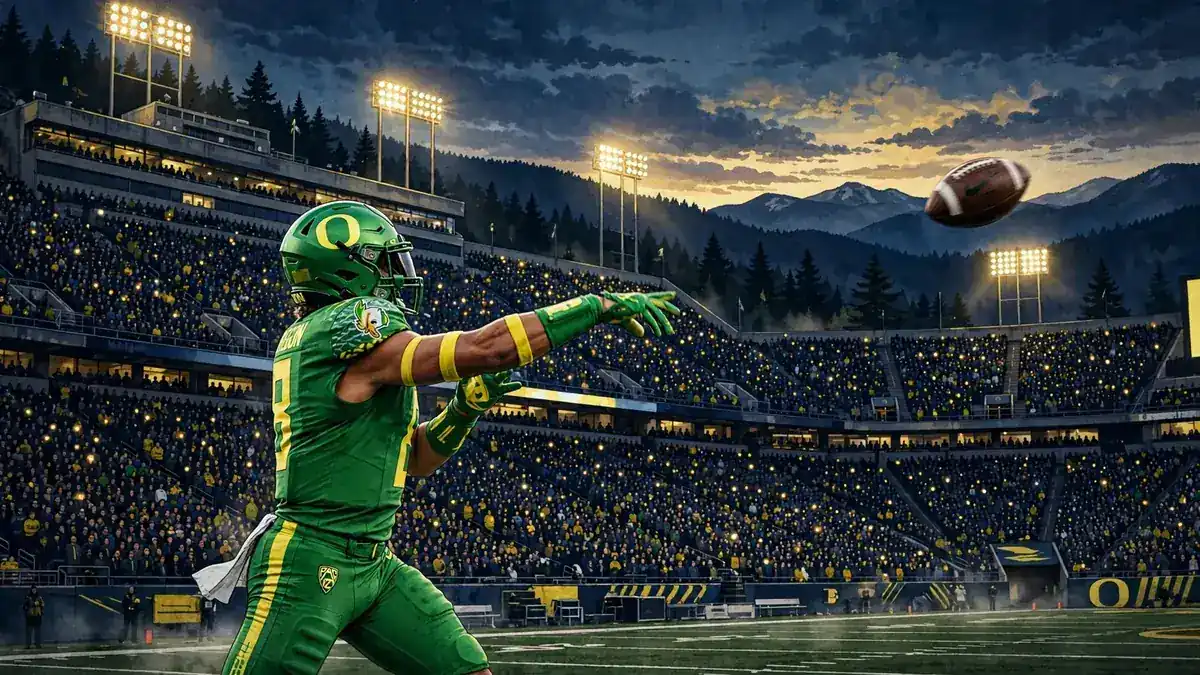
What the numbers do not capture is how much the program changed around him. Oregon went from 4–8 in his freshman year to a conference title and a Rose Bowl win as a senior, and Herbert’s steady, unflashy leadership was the constant through it. Scouts still had doubts — the offense had been conservative, his big-game record was mixed, and some wondered whether the quiet kid from Eugene had the edge for the NFL — but the production, the size and the arm were impossible to ignore. By draft season he was a lock for the top ten.
The 2020 NFL Draft and a Record-Breaking Rookie Season
The 2020 NFL Draft class at quarterback was one of the strongest in years. Joe Burrow went first overall to Cincinnati after his historic season at LSU, Tua Tagovailoa went fifth to Miami, and the Chargers took Herbert sixth overall. He was the third quarterback off the board, and in hindsight the pick looks like the best value of the three — but nobody in Los Angeles expected him to play right away. The plan was for veteran Tyrod Taylor to start while Herbert learned.
The plan lasted one game. Herbert was pressed into the starting job in Week 2 of his rookie season and never gave it back. He threw for 4,336 yards and 31 touchdown passes — an NFL rookie record, breaking Baker Mayfield’s mark of 27 — with 10 interceptions, and was named the NFL Offensive Rookie of the Year. The Chargers went only 6–9 in his starts, but the quarterback question that had hung over the franchise since Philip Rivers’ departure was answered in a single autumn. Herbert’s arm talent was obvious from the first month: the velocity, the deep ball, the ability to throw on the run at his size. What surprised people was the poise. He looked like he belonged from the first snap, and the record book agreed.
That rookie year also set the template for how Herbert’s career would be judged. The numbers were always there. The wins, too often, were not — and the gap between the two would become the defining argument about him.
Becoming the Chargers’ Franchise Quarterback
Herbert’s second season, 2021, was the best of his career by the raw numbers. He threw for 5,014 yards — a Chargers franchise record — with 38 touchdowns, made his first Pro Bowl, and finished among the league’s passing leaders in nearly every category. The Chargers went 9–8 and missed the playoffs on the final weekend, losing a win-and-in game to the Raiders in overtime, but Herbert himself had arrived as a top-tier NFL quarterback. Only Patrick Mahomes and Josh Allen had attempted more passes than Herbert since he entered the league, and his interception rate of 1.6 percent across his first five seasons was the lowest of any quarterback who played in all five of those years.
The 2022 season brought his first playoff appearance — and his first famous heartbreak. The Chargers led the Jacksonville Jaguars 27–0 in the wild-card round and lost 31–30, one of the biggest collapses in playoff history. Herbert threw for 273 yards and a touchdown in that game and did not turn the ball over; the loss was a team failure, not a quarterback failure, but it attached itself to his name anyway. He finished the season with 4,739 yards and 25 touchdowns, playing through a fractured rib cartilage injury suffered in Week 2 that he never used as an excuse.
Then came 2023, the year everything stalled. Herbert fractured the index finger on his throwing hand in December and missed the final four games. The Chargers finished 5–12, head coach Brandon Staley was fired, and the franchise hit reset. Herbert’s numbers that year — 3,134 yards, 20 touchdowns, 7 interceptions in 13 games — were the quietest of his career, and for the first time there were real questions about whether the Chargers were wasting a franchise quarterback. The answer the franchise gave, six months earlier, had been a five-year, $262.5 million extension. The answer the new regime would give was Jim Harbaugh.
The Harbaugh Era and Two Playoff Heartbreaks
Harbaugh arrived in January 2024, a month after coaching Michigan to a national championship, and the pairing with Herbert was billed as the move that would finally turn talent into January wins. The first season delivered on half the promise. Herbert threw for 3,870 yards with 23 touchdowns and just three interceptions — a 101.7 passer rating, the best of his career — and the Chargers went 11–6 and returned to the playoffs. The run-heavy, ball-control offense Harbaugh installed asked Herbert to do less, and he did it more efficiently than ever, with rookie receiver Ladd McConkey emerging as his most trusted target.
Then the wild-card game against Houston undid all of it in one afternoon. Herbert completed 14 of 32 passes for 242 yards with one touchdown and four interceptions in a 32–12 loss, the worst game of his career. He had never thrown more than two interceptions in an NFL game before; he threw four in that one, and became the first player in NFL history to throw more interceptions in a playoff game than he had in the entire regular season. He owned it afterward — “I let the team down” — and the performance stayed with him. A year later he was still talking about it, saying the loss had “stayed” with him, and fans were still arguing about it ahead of the rematch.
The 2025 season brought a second straight 11-win campaign and a second straight playoff berth, but the ending rhymed: another wild-card exit, another game in which the offense that had carried the Chargers all season went quiet at the wrong moment. Herbert’s 2025 line — 3,727 yards and 26 touchdowns in 16 games, per Pro Football Reference’s career totals — was solid, and his cash earnings that year topped $60 million, the most of any NFL player. But the playoff record now read 0–3, and the conversation around him had shifted. The question was no longer whether he was talented enough. It was whether the talent would ever show up in January.
| Season | Games | Passing Yards | Touchdowns | Interceptions | Passer Rating |
|---|---|---|---|---|---|
| 2020 | 15 | 4,336 | 31 | 10 | 98.3 |
| 2021 | 17 | 5,014 | 38 | 15 | 97.7 |
| 2022 | 17 | 4,739 | 25 | 10 | 93.2 |
| 2023 | 13 | 3,134 | 20 | 7 | 93.2 |
| 2024 | 17 | 3,870 | 23 | 3 | 101.7 |
| 2025 | 16 | 3,727 | 26 | 13 | — |
| 2026 (through Week 10) | 9 | 1,720 | 6 | 11 | 71.6 |
Regular-season passing numbers: 2020–2024 and 2026 from Pro Football Reference and the Chargers’ official site; 2025 derived from Pro Football Reference’s career totals. The 2026 line covers games through November 16, 2026.
The 2026 Season: A Brutal Start, Then a First Win
If the first six seasons of Herbert’s career were defined by the gap between his numbers and his team’s results, 2026 blew that gap wide open. The Chargers entered the season with real expectations — Harbaugh in his third year, Mike McDaniel hired as offensive coordinator in the offseason, a roster that had won 11 games in each of the previous two seasons — and then lost their first eight games. The offense went 27 straight drives without a touchdown at one stretch and scored just nine touchdowns all season to that point, the fewest in the league. Herbert threw five touchdowns against ten interceptions through the first seven games, was sacked 21 times in the first six, and took a career-high eight sacks in a 44–22 home loss to Houston on November 8.
The low point came in that Texans game, when Herbert hurt a finger and briefly left the field. The fear was a fracture; the tests showed he had avoided one, and he was back at practice the following week with no injury designation for the Week 11 game against the New York Jets on November 22. He has played every game of the 2026 season and has not appeared on an injury report all year — the one steady fact in a season with almost nothing else steady about it.
The first win finally came on Monday night, November 16, 2026, a 23–20 victory over the Baltimore Ravens. Herbert’s line that night was modest — 12 of 18 for 129 yards, no touchdowns and no interceptions — but he ran seven times for 51 yards and a touchdown, including the kind of physical, broken-play running that had been missing from the offense all season. Through nine games his 2026 numbers read 156 of 253 for 1,720 yards, six touchdowns and 11 interceptions, a 71.6 passer rating, with 241 rushing yards and a rushing score. By every measure it is the worst stretch of his career, and the projections are grim — one model had him finishing with roughly 3,400 yards, 14 touchdowns and 20 interceptions behind a 74 rating. But the win over Baltimore at least stopped the bleeding, and with four years left on his contract, the story of Herbert’s prime is still being written. What the 2026 season has already settled is that no quarterback, not even one with his arm, can outplay a broken offense on his own.
Note on the 2026 injury news: a report of an ACL injury involving Patrick Mahomes circulated in recent search results. That report is about Mahomes, not Herbert. Herbert has no injury designation for Week 11 and has played every game this season.
The Money: Contract, Salary and Endorsements
The deal that changed Herbert’s financial life was signed on July 25, 2023: a five-year, $262.5 million extension that keeps him with the Chargers through the 2029 season. At the time it made him one of the highest-paid players in NFL history, at $52.5 million a year on average, with $218.7 million in total guarantees and $133.7 million guaranteed at signing, plus a $16.1 million signing bonus. The structure matters as much as the headline number: NFL contracts pay out over years, not in a lump sum, and the guaranteed money is the part a player can truly count on. Herbert’s cash flow tells the story — his 2025 cash earnings topped $60 million, the most any NFL player collected that year, according to reporting on Spotrac’s figures, and his career NFL earnings reached roughly $96 million through the 2025 season.
His 2026 base salary is $24 million, with the deal’s biggest cash years still ahead of him: a reported $36 million in 2027, $52 million in 2028 and $50.5 million in 2029. That schedule is why his net worth today is a fraction of his contract value — most of the $262.5 million has not been paid yet — and why his wealth is set to climb steeply over the next four seasons even if he never signs another deal. For the full story of what he has banked so far, see the full story of Justin Herbert’s net worth on GuideNetWorth, which breaks down the contract year by year.
Off the field, Herbert earns around $10–11 million a year from endorsements, according to Forbes. The partner list reads like a roster of blue-chip American brands: Nike, Panini, United Airlines, SoFi, Dr. Squatch, Callaway and Verizon, with Bose and Subway also reported among his deals. That is a strong off-field number for a quarterback who keeps a low public profile and rarely chases the spotlight — it reflects the market’s judgment that Herbert’s image is clean, durable and broadly appealing, even in a season like 2026. The endorsement income also explains part of the gap between his contract and his net worth: it is real money, paid annually, on top of the salary.
There is one more piece of the money picture that rarely gets mentioned. Herbert has never been a holdout, never restructured loudly, never made his contract a public drama. He signed the extension, went back to work, and let the deal speak for itself. That low-drama approach has kept his market value intact through two coaching changes and a losing season — teams pay for the arm and the availability, and Herbert has started every game he has been healthy enough to play.
How Much Is Justin Herbert Worth in 2026?
Justin Herbert’s net worth in 2026 is an estimated $40 million. That figure comes from Celebrity Net Worth, which updated its Herbert profile on July 29, 2026, and it is backed by BounceMojo, which published the same $40 million estimate in August 2026 after reviewing his contract and endorsement income. Not every outlet agrees, and a fair report says so plainly: Velontia puts Herbert at $45 million in 2026, which sits close enough to the anchor to fit inside a sensible range, while NetWorthBreakdown goes much higher at $70 million and SurpriseSports still shows a stale $5 million figure from an old, un-updated page. The honest range is $40–45 million, anchored at $40 million. For the year-by-year breakdown and the full adjudication, see Justin Herbert’s net worth on CelebAmerica.
The reason the number is not $262.5 million is the same reason it is not $5 million. A net worth is money already banked, minus taxes, agent fees and spending, plus endorsements and investments — not the total value of a contract still being played out. Herbert has earned roughly $96 million in career NFL salary through 2025, and California taxes, a standard agent fee and six years of life at the top of the league take a large share of that before a dollar is saved. What remains, plus endorsement income and the equity in his home, is the $40 million figure. It is a starting point, not a ceiling: with more than $160 million in contract cash still scheduled through 2029, his net worth should roughly double over the next four seasons even before endorsements.
Houses, Cars and Lifestyle: How Herbert Spends It
For a quarterback on a quarter-billion-dollar contract, Herbert lives a strikingly quiet life. The one big purchase on the public record is his home: a Southern California estate he bought in 2022 for $5.25 million, according to MansionsRadar, which profiled the property in 2026. He lives in Southern California, close to the Chargers’ facility, and the house is the anchor of a lifestyle that otherwise draws little attention.
There is no verified reporting of a car collection, a watch collection or a property portfolio, and this article will not invent one. What is on the record is a pattern: Herbert does not flaunt wealth, does not chase celebrity, and spends his public energy on football. He is known for fishing — the hobby goes back to the club he co-founded at Sheldon High — and for keeping his circle small. His parents still live in Eugene, his brothers are close, and his public appearances outside football are rare. In a league where many stars build second careers as brands, Herbert’s brand is mostly that he does not have one. The endorsement deals come to him anyway, which may be the best evidence that the quiet approach works.
Net Worth Growth: Herbert’s Money, Year by Year
Herbert’s wealth has followed the shape of his contract: a modest start on a rookie deal, a step up with each season, then a sharp jump when the extension kicked in.
| Year | What Happened | Estimated Net Worth |
|---|---|---|
| 2020 | Rookie season; four-year rookie contract worth about $26.6 million | $2–3 million |
| 2021 | Franchise-record 5,014 yards; first Pro Bowl; endorsements begin to scale | $8–10 million |
| 2022 | First playoff appearance; buys $5.25 million Southern California home | $15–18 million |
| 2023 | Signs five-year, $262.5 million extension in July | $20–25 million |
| 2024 | Harbaugh era; 11–6 season; extension cash begins to flow | $30–35 million |
| 2025 | Second straight 11-win season; $60 million-plus in cash earnings | $38–42 million |
| 2026 | Extension in full swing; Celebrity Net Worth updates to $40 million | $40 million (range $40–45 million) |
Year-by-year figures before 2026 are estimates built from the contract schedule, reported career earnings and the published net-worth anchors; they are directional, not audited. The 2026 figure is anchored by Celebrity Net Worth (July 29, 2026) and BounceMojo (August 2026).
The shape of the table is the point. Herbert’s net worth roughly doubled between 2023 and 2026, and the same math points to another doubling by 2029, when the extension runs out. The open question is what comes after: a second extension, signed at age 31, would likely be the biggest contract of his career — if the Chargers still see him as their quarterback, and if the 2026 season turns out to be a blip rather than a turn.
Personal Life: Family, Madison Beer and Life Off the Field
Herbert’s personal life stayed almost entirely private for the first five years of his NFL career, and that was by design. He rarely discusses relationships in interviews, keeps his social media presence minimal, and has never been part of the celebrity circuit that surrounds many franchise quarterbacks. What changed in July 2026 was reported by Celebrity Net Worth’s updated profile: Herbert became engaged to singer Madison Beer. The two had been dating since 2025, and the engagement was the first time his private life had made headlines in a serious way. He is not married as of November 2026.
Beer, born in 1999, is a singer and songwriter who first found fame as a teenager and has built a substantial music career of her own. The relationship pairs two people who are famous in very different worlds — football and pop music — and both have kept it notably low-key since the news broke. There has been no public engagement party coverage, no magazine spread, no joint interview tour. That restraint fits everything else about Herbert’s public life.
Family remains the center of it. His father Mark coached him as a boy and still watches from Eugene; his mother Holly is the steady presence behind all three boys’ careers; older brother Mitchell played at Montana State and younger brother Patrick followed Justin to Oregon and into the NFL. The Herberts are an Eugene family in the plain sense — rooted in the town, tied to the university, and known locally long before the middle son became famous. Herbert has spoken about how growing up minutes from Autzen Stadium shaped him, and it shows in the way he still carries himself: the hometown kid who never really left, even after the money arrived.
Off the field, the interests are the same ones he had at Sheldon: fishing, the outdoors, and a quiet competitiveness that teammates describe as relentless without being loud. He is 6 feet 6 inches and 236 pounds, ran a 4.68-second 40-yard dash at the NFL Combine, and still moves like the basketball player he was in high school. The science background has not gone away either — teammates have joked for years that the quarterback with the biology degree is the smartest man in the room, and the Campbell Trophy on his shelf backs that up.
The Knock on Herbert: Big Games and the Playoff Record
No honest biography of Justin Herbert can skip the argument that follows him everywhere: the numbers are elite, the wins are not. He is 0–3 in the playoffs. He has thrown more interceptions in a single playoff game than in an entire regular season. His teams have blown a 27–0 playoff lead, lost a win-and-in finale in overtime, and collapsed in the wild-card round two years running under a Hall of Fame coach. The critics’ case is simple and it is not invented: franchise quarterbacks are ultimately judged in January, and Herbert has not won there yet.
The defense is just as simple, and it is not invented either. Herbert has played behind some of the league’s worst pass protection — since 2024 he has taken 391 quarterback hits, the most of any quarterback in that span, and the Chargers have allowed 112 sacks. In the 2024 wild-card loss he was pressured on 19 of 37 dropbacks. His interception rate across his first five seasons was the lowest in the league among full-time starters. And the two playoff collapses on his record were team failures in which he personally did not turn the ball over in one and was let down by protection in the other. Both things can be true: Herbert has not won a playoff game, and Herbert has rarely been the reason his teams lost one.
The 2026 season has made the argument harder for both sides. His numbers this year — six touchdowns against 11 interceptions through nine games — are the worst of his career, and for the first time the criticism is about his play, not just his circumstances. The sacks, the interceptions in every game, the stalled drives: some of that is on the line and the scheme, and some of it is on the quarterback. What happens next will settle the debate more than any article can. If Herbert returns to form and the Chargers rebuild around him, 2026 will read as an aberration. If the struggles continue, the conversation will change from “when will he win in January” to “is he still the answer at all.” At 28, with four years left on his deal, he still has time to write the ending. But the clock on that question is now ticking audibly.
Justin Herbert Biography FAQs
How old is Justin Herbert?
Justin Herbert is 28 years old as of November 2026. He was born on March 10, 1998, in Eugene, Oregon.
Where is Justin Herbert from?
Justin Herbert is from Eugene, Oregon. He was born and raised there, attended Sheldon High School in Eugene, and played college football for the Oregon Ducks in the same town, minutes from the family home.
What is Justin Herbert’s net worth in 2026?
Justin Herbert’s net worth in 2026 is an estimated $40 million, anchored by Celebrity Net Worth’s profile update of July 29, 2026, and matched by BounceMojo in August 2026. The honest range is $40–45 million, since Velontia puts him at $45 million.
How much is Justin Herbert’s contract worth?
Justin Herbert signed a five-year, $262.5 million contract extension with the Los Angeles Chargers on July 25, 2023, running through the 2029 season. It averages $52.5 million a year and includes $218.7 million in total guarantees.
Is Justin Herbert married or engaged?
Justin Herbert is engaged to singer Madison Beer. The engagement was reported in July 2026, after the two had been dating since 2025. He is not married as of November 2026.
What college did Justin Herbert go to?
Justin Herbert went to the University of Oregon, where he played from 2016 to 2019. He threw for 10,541 yards and 95 touchdowns for the Ducks, led them to the Pac-12 title in 2019, and was named offensive MVP of the Rose Bowl on January 1, 2020.
What happened to Justin Herbert in the 2026 season?
Herbert and the Chargers started the 2026 season 0–8, the worst stretch of his career, with Herbert throwing six touchdowns against 11 interceptions through nine games. He hurt a finger in the Week 9 loss to Houston but avoided a fracture, and the Chargers finally won their first game on November 16, 2026, beating the Baltimore Ravens 23–20.
How tall is Justin Herbert?
Justin Herbert is 6 feet 6 inches tall and weighs 236 pounds. He ran a 4.68-second 40-yard dash at the 2020 NFL Combine.
Final Thoughts: The Bottom Line
Justin Herbert’s biography, so far, is the story of a quarterback who did everything right except win the games that define legacies. He grew up in the shadow of the stadium he would star in, survived a broken leg and a broken collarbone, turned down the NFL for one more year at Oregon and was rewarded with a Rose Bowl MVP award, then set a rookie passing record and signed a $262.5 million contract before his 26th birthday. He is worth an estimated $40 million at 28, engaged, healthy, and under contract through 2029 — and he has never won a playoff game.
That contradiction is what makes him worth writing about. The talent has never been in doubt; the arm, the size, the intelligence and the durability are all real. The 2026 season is the first real test of whether the rest of the story holds together — whether a quarterback who has always been the answer can survive a season in which the questions are all about him. If he comes through it, the biography gets a second act. If he does not, the first act will read very differently. Either way, the kid from Eugene who stayed home, studied biology and threw 95 touchdowns for the Ducks has already built a career most quarterbacks would envy. The ending is still unwritten. For more long-form profiles like this one, browse our Biography section.
Sources and How We Estimated
Named sources for this article: Celebrity Net Worth (net worth $40 million, profile updated July 29, 2026; engagement to Madison Beer, July 2026); BounceMojo ($40 million estimate, August 2026; endorsement income); Los Angeles Chargers (official roster and 2026 season statistics); Pro Football Reference (season-by-season passing statistics and career totals); University of Oregon Athletics (college career totals, Rose Bowl MVP, Pac-12 title); Forbes (endorsement income of around $10–11 million a year); Spotrac (contract figures and 2025 cash earnings, via reporting); Wikipedia (family background, high school and college details, cross-checked against the sources above).
How we estimated: the net-worth figure is anchored to Celebrity Net Worth’s July 29, 2026 update of $40 million and corroborated by BounceMojo’s August 2026 estimate of the same amount. Velontia’s $45 million figure sets the top of an honest $40–45 million range. Higher outlier estimates ($70 million) and stale low figures ($5 million) were discounted as inconsistent with reported career earnings of roughly $96 million through 2025 and the contract’s payment schedule. Year-by-year net-worth figures before 2026 are estimates built from that schedule and the published anchors, not audited accounts. All net-worth figures are estimates from public sources and may differ from private reality.