José Andrés is a Spanish-American chef, restaurateur, author and humanitarian whose life reads like two careers folded into one: a restaurant empire that brought Spanish tapas to the United States, and a disaster-relief organisation that has served hundreds of millions of meals around the world. As of November 2026, his net worth is estimated at $50 million to $70 million, anchored at $50 million by Celebrity Net Worth and repeated in Alux’s November 2026 ranking of the richest celebrity chefs.
Born José Ramón Andrés Puerta on 13 July 1969 in Mieres, Asturias, Spain, he is 57 years old in 2026. He arrived in the United States at 21 with little money, took over the kitchen at Jaleo in Washington, D.C. in 1993, built the José Andrés Group (formerly ThinkFoodGroup) into a portfolio of around 40 restaurants, founded World Central Kitchen after the 2010 Haiti earthquake, and received the Presidential Medal of Freedom in January 2025. This biography covers his childhood in Spain, his training at elBulli, his American rise, his money, his family, and the honours that now sit beside his name.
Last updated: 20 November 2026. By Celebamerica Editorial Staff.
Quick Facts
| Full Name | José Ramón Andrés Puerta |
|---|---|
| Date of Birth | 13 July 1969 |
| Birthplace | Mieres, Asturias, Spain |
| Age (2026) | 57 years old |
| Nationality | Spanish-American (naturalised U.S. citizen, December 2013) |
| Estimated Net Worth | $50 million to $70 million as of November 2026 (anchored at $50 million by Celebrity Net Worth) |
| Primary Income Sources | Restaurant group equity (José Andrés Group), cookbooks, television, speaking and media work |
| Key Ventures | Jaleo, minibar by José Andrés, Zaytinya, The Bazaar, World Central Kitchen, Global Food Institute at George Washington University |
| Spouse | Patricia Fernández de la Cruz (“Tichi”), married 1995 |
| Children | Three daughters: Carlota, Inés and Lucía |
| Home | Bethesda, Maryland, United States |
| Top Honours | Presidential Medal of Freedom (2025), National Humanities Medal (2015), James Beard Outstanding Chef and Humanitarian of the Year |
Table of Contents
- Quick Facts
- Early Life in Asturias and Catalonia
- Culinary School and Three Years at elBulli
- Arrival in America and the Jaleo Breakthrough
- Building the José Andrés Group Empire
- The Money: Income Streams Behind the Fortune
- Net Worth Breakdown and Growth Timeline
- World Central Kitchen: Feeding the World After Disaster
- Books, Television and Media Career
- Awards and Honours
- Personal Life: Wife, Daughters and Home
- Controversies and the Trump Hotel Lawsuit
- How José Andrés Compares With Other Celebrity Chefs
- Frequently Asked Questions
- Final Thoughts
- Sources and Reporting
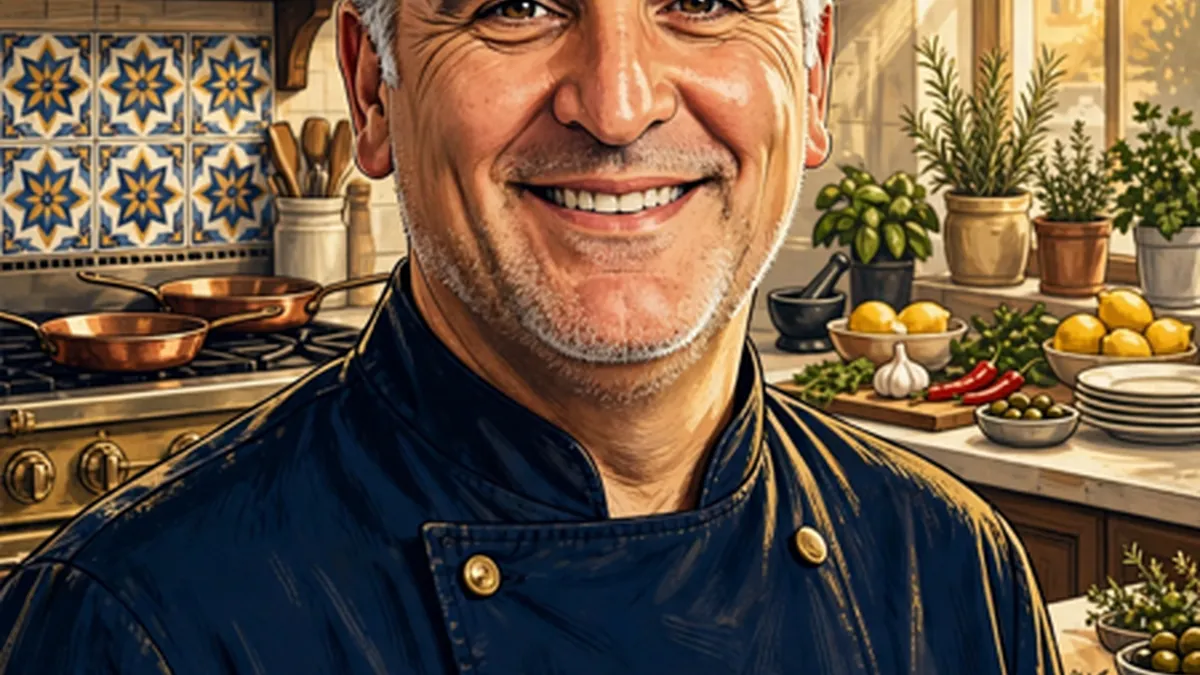
Early Life in Asturias and Catalonia
José Ramón Andrés Puerta was born on 13 July 1969 in Mieres, a mining town in Asturias in north-west Spain. His parents, Mariano Andrés and Marisa Puerta, were both nurses. Food was part of daily life at home, and the boy who would one day cook for presidents and feed disaster zones first learned to love a kitchen the ordinary way: watching his parents cook, eating together, and treating a shared meal as the centre of the day.
When José was six, the family moved to Catalonia, in north-east Spain. The move mattered more than it looked at the time. Catalonia in the 1970s and 1980s was one of the most exciting food regions in Europe, and Barcelona was becoming a city where chefs were treated as artists. A child growing up there absorbed a food culture that valued fresh markets, long lunches, small shared plates and fierce regional pride — all of which would later show up in his American restaurants.
Andrés enrolled in culinary school in Barcelona at the age of 15. That is young to choose a trade, and it says something about how sure he was. While other teenagers were still deciding what they wanted to be, he was already learning knife work, sauces, service and the discipline of a professional kitchen. The school gave him technique; what came next gave him imagination.
At 18, he had to complete his Spanish military service. He was assigned to cook for an admiral — a posting that sounds comfortable, but it put a teenager in charge of feeding a senior officer and his guests, and it taught him to cook under pressure for people who expected the best. It was also, in its own way, a first taste of cooking as a form of diplomacy: food as a way of making people feel welcome, respected and at ease.
Culinary School and Three Years at elBulli
After culinary school, Andrés found his way to the restaurant that would shape his cooking more than any other: elBulli, on the Catalan coast, run by Ferran Adrià. Adrià was turning cooking upside down — foams, spheres, jellies, dishes that looked like one thing and tasted like another, flavours delivered in forms nobody had seen before. For a young chef trained in classical technique, it was like being handed a new language.
Andrés worked at elBulli for three years, from 1988 to 1990. He learned Adrià’s method of questioning everything: why must a soup be served in a bowl, why must an olive look like an olive, what happens if you take a familiar flavour and rebuild it from scratch? That habit of asking “what if?” never left him. Years later, at his tiny tasting counter minibar in Washington, D.C., diners would be served mojitos as squares to chew and olives that burst in the mouth — direct descendants of the elBulli years.
In December 1990, Adrià fired him. The parting is part of the legend now, and Andrés has never hidden it. He was 21, out of a job, and at a crossroads. He decided to leave Spain for the United States. It was a bold move for a young chef with no money and no contacts in America, and it is the decision on which everything else in his life turns. He arrived in New York City in 1991 to cook at an outpost of a Spanish restaurant, Eldorado Petit, in Midtown Manhattan.
New York taught him a different lesson from elBulli. In Spain he had learned how to invent; in New York he learned how to survive in a commercial kitchen in a foreign city, cooking for customers who had never tasted real Spanish food. The two lessons together — invention plus stamina — became the foundation of his American career.
Arrival in America and the Jaleo Breakthrough
In 1993, two years after arriving in the United States, Andrés was hired to lead the kitchen at Jaleo, a new tapas restaurant in Washington, D.C. The job was offered by Rob Wilder and Roberto Álvarez, and it changed his life. Washington in the early 1990s was not a city famous for Spanish food. Most Americans had never eaten tapas. The small-plates idea — ordering many little dishes to share, grazing and talking for hours — was foreign to a dining culture built around a starter, a main and a dessert, eaten by one person alone.
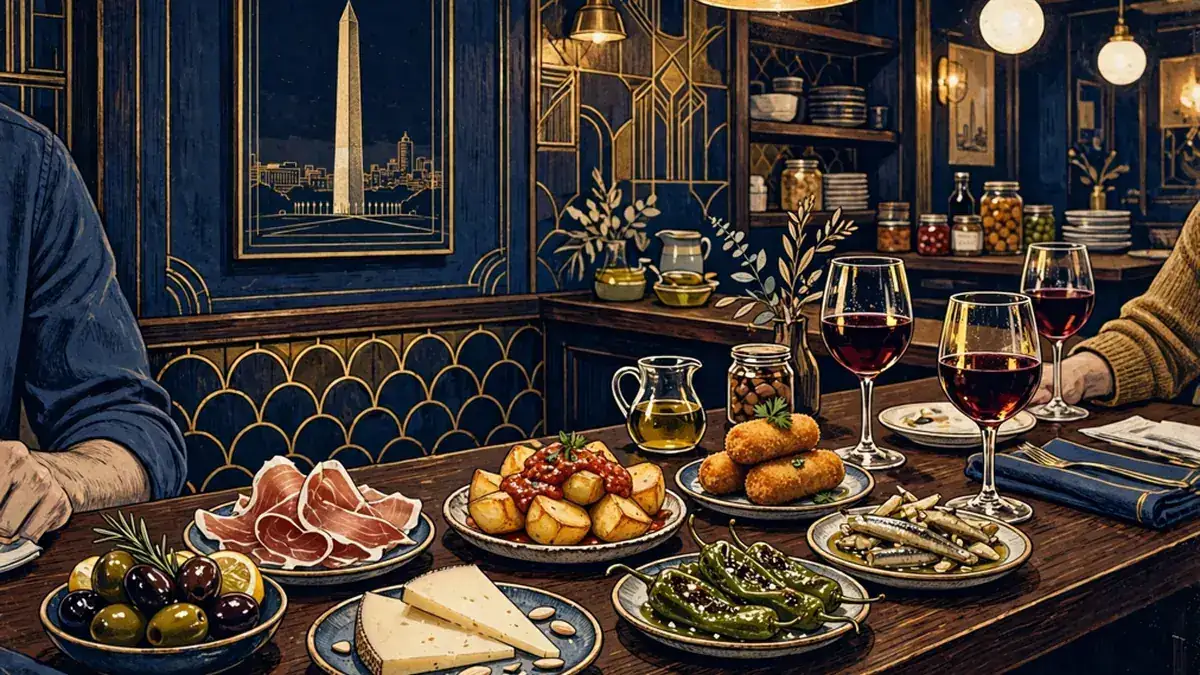
Jaleo made it work. Andrés cooked the food he had grown up with, but with the flair he had learned from Adrià: jamón Ibérico sliced paper-thin, patatas bravas with a kick, croquetas, gambas al ajillo, pan con tomate, olives marinated in herbs. The portions were small, the prices were modest, and the room was loud and happy. People came for dinner and stayed for the evening. Within a few years, Jaleo was credited with popularising tapas in the United States — a claim repeated by the White House itself when it awarded him the Presidential Medal of Freedom in 2025.
Success at Jaleo gave Andrés room to experiment. In 1995 he took over the Nuevo Latino menu at Café Atlántico, next door to Jaleo. Then came Zaytinya, a Mediterranean small-plates restaurant drawing on the food of Greece, Turkey and Lebanon, and Oyamel, a Mexican restaurant built around the same sharing idea. Each new opening taught him something: how to run a bigger team, how to keep quality steady across rooms, how to make a concept travel.
His boldest experiment came in 2003, when he opened minibar inside Café Atlántico — a six-seat counter where a handful of diners were served around 25 tiny courses by a team of chefs. It was elBulli thinking transplanted to Washington: playful, precise, theatrical, and expensive. Many people thought a six-seat restaurant could never pay. Instead, minibar became one of the most celebrated dining rooms in America, eventually earning two Michelin stars when the Michelin Guide came to Washington, D.C. in 2016, and moving to a stand-alone twelve-seat room of its own.
Building the José Andrés Group Empire
In 2006, Andrés partnered with Rob Wilder to form ThinkFoodGroup, the parent company that gathered his restaurants, media work and philanthropic projects under one roof. The deal made Andrés a co-owner of the restaurants he had been cooking in, rather than simply their chef. That shift — from employee to owner — is where the money story really begins. A salaried chef, however famous, earns a salary. An owner builds equity, and equity is what turns a good career into a fortune.
From that base, the group grew steadily: more Jaleo locations, The Bazaar by José Andrés in Miami Beach, Washington and New York, China Poblano and China Chilcano, é by José Andrés in Las Vegas (a sister tasting counter to minibar), barmini, the cocktail bar beside minibar, and restaurants in Los Angeles, Las Vegas, Miami, Puerto Rico, Philadelphia and beyond. A Fast Company profile from 2018 counted 29 properties in eight cities across the United States, Puerto Rico and Mexico. More recent profiles, including the World Central Kitchen biography, put the count at around 40 restaurants worldwide under what is now called the José Andrés Group — the name the company adopted as ThinkFoodGroup evolved.
The group’s model is worth understanding, because it explains both the scale and the risk. Andrés does not run one big restaurant; he runs many concepts, each aimed at a different diner. Jaleo is the friendly neighbourhood tapas bar. Minibar is the once-in-a-lifetime tasting counter. The Bazaar is theatre — Spanish food with a playful, modern twist. Zaytinya is Mediterranean sharing plates. Beefsteak, his plant-centred fast-casual chain, aimed at lunch crowds who want vegetables to taste like a treat rather than a duty. If one concept cools, the others carry the group. That spread is a big part of why the business has lasted for three decades.
Growth brought partners and deals. In 2018, ThinkFoodGroup struck a partnership with Compass Group, the food-service giant, to develop new concepts and expand existing ones, including Beefsteak. Partnerships like that bring capital and reach a chef could never raise alone — but they also mean shared control, and the details of who owns what share of the group are private. That privacy is exactly why published net worth figures for Andrés are estimates, not audited facts, and why honest reporting gives a range rather than a single confident number.
Geography also tells the story. Washington, D.C. remains the heart of the empire — so many of his restaurants sit within a few blocks of each other near the National Mall that a visitor can walk from Jaleo to Oyamel to Zaytinya to minibar in minutes. But the brand now stretches to Las Vegas, Los Angeles, Miami, New York, Philadelphia, Chicago, Orlando, Dubai and beyond. Each new city is a bet: that the José Andrés name, built on Spanish food and warm hospitality, travels as well as the food itself.
The Money: Income Streams Behind the Fortune
José Andrés’s fortune does not come from one pay cheque. It comes from several streams that reinforce each other: restaurant ownership, cookbooks, television, speaking, and the brand value that his humanitarian work has added to his name. Understanding each stream separately is the only honest way to judge the published estimates.
Restaurant equity is the largest piece. As co-owner of a group with around 40 venues, Andrés holds equity in a private business whose value is not published. Alux’s November 2026 ranking, which puts him at $50 million, describes its valuation basis plainly: “his equity in a restaurant group, cookbooks and TV work.” Fine-dining restaurants run on thin margins — often single digits after rent, labour and food costs — but a group of 40 venues, including high-priced tasting counters where a single dinner can cost hundreds of dollars per person, adds up to real annual revenue. The value sits in the brand, the leases, the teams and the repeat customers, not in a bank balance anyone can look up.
Cookbooks add steady income. His first book, Tapas: A Taste of Spain in America, was published in 2005. Since then he has published a shelf of titles, including Made in Spain, Tapas Deck, Vegetables Unleashed, We Fed an Island — his account of the Puerto Rico hurricane response, which became a New York Times bestseller — and The World Central Kitchen Cookbook, also a bestseller. Cookbook advances and royalties for a chef of his profile are meaningful but modest next to restaurant equity; their real value is that each book keeps his name in front of readers and drives diners to his restaurants.
Television and media pay in fees and exposure. Andrés has hosted and appeared in television series including Made in Spain on PBS, competed on Iron Chef America, and appeared on countless food and talk shows. He hosts a podcast and is a regular presence on American television whenever food, immigration or disaster relief is in the news. TV fees for a chef of his standing run into the tens of thousands of dollars per appearance or episode, but the bigger return is reputational: every appearance is advertising for the restaurant group that no marketing budget could buy.
Speaking and academic work bring fees and standing. As a professor and the founder of the Global Food Institute at George Washington University, Andrés holds an academic role that pays a salary and, just as importantly, puts him at the centre of policy conversations about food, hunger and climate. Speaking fees for a Presidential Medal of Freedom recipient with his story command premium rates, though no public record lists them.
What does not count as personal wealth matters too. World Central Kitchen is a non-profit. The $100 million Courage and Civility Award that Jeff Bezos gave Andrés in 2021 went to the organisation, not to him personally — it was money to spend on feeding people, and Andrés has been clear about that. Likewise, the hundreds of millions of dollars WCK has raised — nearly $30 million in 2019, then $250 million in 2020, according to its own reporting — are charitable funds, not income. Any net worth estimate that folds WCK’s fundraising into Andrés’s personal fortune is wrong, and readers should treat such claims with suspicion. The outlier figures circulating online, including a $200 million to $300 million claim on one low-authority site, appear to make exactly that mistake, confusing the scale of his charity with the size of his bank account.
The honest figure: Celebrity Net Worth lists José Andrés at $50 million, and Alux’s November 2026 ranking agrees at $50 million. Other biography sites give a $50 million to $70 million range. We publish that range, anchored at $50 million, because the two most careful sources agree on the lower figure and the group is private, so a higher figure cannot be verified.
Net Worth Breakdown and Growth Timeline
No public filing states José Andrés’s net worth. He has never sold his company, never taken it public, and never published his accounts. The figures below are therefore an estimate built from named sources, and the table shows the shape of his career rather than a bank statement.
| Period | What happened |
|---|---|
| 1991–1993 | Arrives in New York with little money; cooks in Manhattan; moves to Washington, D.C. to run Jaleo. Wealth: negligible — a working chef’s wages. |
| 1993–2003 | Jaleo succeeds; Café Atlántico, Zaytinya and Oyamel open; minibar launches in 2003. Wealth: a respected chef’s salary plus growing reputation, still modest in money terms. |
| 2006 | ThinkFoodGroup formed with Rob Wilder; Andrés becomes a co-owner. Wealth: equity begins to build — the turning point in the money story. |
| 2010–2017 | World Central Kitchen founded after Haiti; Puerto Rico response in 2017 makes him a global figure; We Fed an Island becomes a bestseller. Wealth: rising, as the brand and the book sales grow. |
| 2018–2021 | Compass Group partnership; James Beard Humanitarian of the Year (2018); Bezos gives WCK $100 million in 2021. Wealth: group expands toward 30–40 venues; published estimates settle near $50 million. |
| 2023–2026 | Presidential Medal of Freedom (January 2025); Global Food Institute grows; José Andrés Group reaches around 40 restaurants. Wealth: $50 million to $70 million, per the range published by biography outlets in 2026. |
Why the range, and why so wide at the top? Because the value of a private restaurant group depends on things outsiders cannot see: how much of each restaurant Andrés owns outright, how much debt the group carries, how the Compass Group partnership is structured, and how the leases are valued. A $50 million figure assumes a conservative value for that equity. A $70 million figure assumes the brand premium — the fact that the José Andrés name itself now opens doors, sells books and fills rooms — is worth more. Both are defensible; neither can be proved. What can be said with confidence is that the $2 million to $4 million figure on one low-quality biography site is far too low for a man who co-owns 40 restaurants, and the $200 million to $300 million figure on another is far too high, built by counting charity money as personal wealth.
For a sense of scale, his fortune sits well below the biggest celebrity-chef fortunes. Gordon Ramsay, whose global restaurant and television empire is far larger, is listed near $220 million by Alux in November 2026 — a useful comparison, because Ramsay’s scale of television work dwarfs Andrés’s, and his restaurant count is larger. Jamie Oliver, another chef who built a fortune from television and books as much as from restaurants, sits in the same broad band above Andrés. The comparison is instructive: Andrés’s wealth is real, but it is the wealth of a restaurateur and humanitarian, not of a television mogul.
World Central Kitchen: Feeding the World After Disaster
If the restaurant empire is one half of José Andrés’s life, World Central Kitchen is the other — and, by now, the half the world knows him for. The idea began before the organisation did. For years Andrés had volunteered with DC Central Kitchen, a Washington non-profit that turned surplus food into meals for people in need. He liked the model: cook real food, hire local people, feed people with dignity rather than handing out parcels.
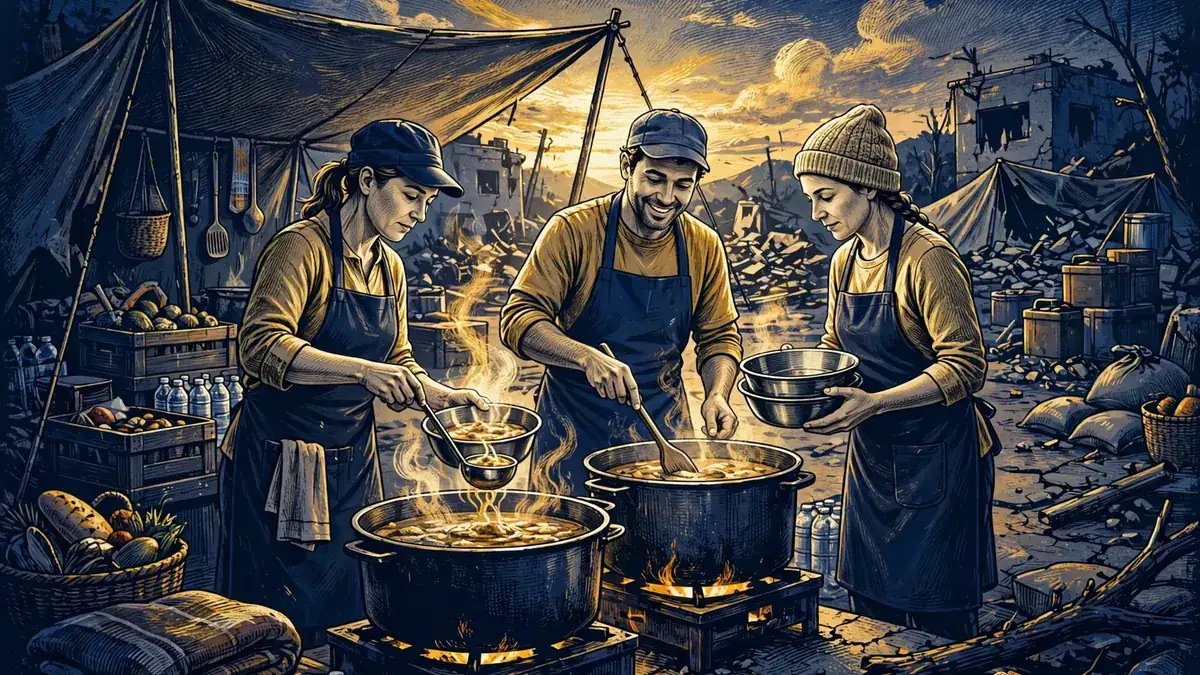
Then came the Haiti earthquake of January 2010. Andrés flew to Port-au-Prince and started cooking — not the imported emergency rations aid agencies usually bring, but food Haitians actually wanted to eat, cooked by local chefs in local kitchens. The experience convinced him that disaster relief was broken: too slow, too distant from the people it was meant to help, too willing to serve food nobody recognised. He founded World Central Kitchen later that year, with a simple idea at its heart: when disaster strikes, go first, cook hot food, buy from local farmers and hire local cooks, so the relief effort feeds the economy as well as the people.
The model was tested in full after Hurricane Maria devastated Puerto Rico in 2017. Andrés arrived within days and built a network of kitchens and volunteers across the island. His teams served more than 3.5 million meals in the months after the storm, and he wrote about the experience in We Fed an Island, which became a New York Times bestseller. The book did two things at once: it told a gripping story, and it made a policy argument — that food relief should be run by people who know food, not only by people who know logistics.
Since then, WCK has worked in the Dominican Republic, Nicaragua, Zambia, Peru, Cuba, Uganda, Cambodia, Ukraine, Gaza, Lebanon, Turkey, Syria, Spain and across the United States, including during the COVID-19 pandemic and the 2025 Los Angeles wildfires. Its own biography of Andrés says the organisation has served more than 300 million chef-prepared meals; other profiles put the count above 500 million, reflecting later counting dates. Either way, the scale is extraordinary for an organisation that began with one chef and a plane ticket to Haiti.
The money behind WCK grew just as fast. The organisation raised almost $30 million in 2019, then $250 million in 2020, as the pandemic and a string of disasters pushed donations upward. In 2021, Jeff Bezos gave Andrés $100 million through his Courage and Civility Award, to be spent through WCK. Andrés runs the organisation with a team of around 200 colleagues, including chief executive Erin Gore. He remains its founder and “Chief Feeding Officer” — a job title he chose himself, and one that tells you how he sees the work.
The work has also carried a heavy cost. In April 2024, seven WCK workers were killed in Gaza in Israeli drone strikes, including an American citizen. Andrés spoke publicly and forcefully about their deaths, and the incident drew global attention to the risks aid workers face. He has been nominated for the Nobel Peace Prize by members of the U.S. Congress, and his humanitarian honours now outweigh his cooking awards in most profiles of him.
Books, Television and Media Career
Andrés is a prolific author. His first book, Tapas: A Taste of Spain in America (2005), was a natural extension of Jaleo — the recipes of the restaurant, written for home cooks. It was followed by Made in Spain: Spanish Dishes for the American Kitchen, tied to his PBS television series of the same name, and by books that show the range of his interests: Tapas Deck, a set of recipe cards; Vegetables Unleashed, a love letter to plant-based cooking; We Fed an Island, the Puerto Rico story; and The World Central Kitchen Cookbook, a collection of recipes from the chefs and kitchens of the relief effort.
On television, he is one of the most recognisable Spanish voices in American food. Made in Spain took PBS viewers around his home country, cooking in markets, villages and family kitchens. He has competed on Iron Chef America, judged and guest-starred on cooking competitions, and appeared on news and talk shows whenever a hurricane, earthquake or war puts food relief in the headlines. His screen manner — fast-talking, funny, warm, switching between Spanish and English mid-sentence — is part of the brand. People remember him after one appearance, and that memorability is worth money to a restaurant group.
He also hosts a podcast and is active on social media, where his posts from disaster zones — short videos from a kitchen in Ukraine, a market in Gaza, a field kitchen in North Carolina after a hurricane — reach millions of people directly, without a network in between. That direct line to the public is part of how WCK raises money so fast after a disaster: Andrés can show donors, in real time, what their money is cooking.
His academic work is the quieter part of the media picture, but it matters. At George Washington University, he founded the Global Food Institute, which studies food systems, hunger and climate. He teaches there, and the institute gives his arguments about food policy an institutional home. It is also a sign of how far he has travelled from the 15-year-old in culinary school: the chef is now a professor, shaping how the next generation thinks about food.
Awards and Honours
José Andrés has won honours in two worlds — cooking and public service — and the list keeps growing. On the cooking side, he has won multiple James Beard Awards, including the foundation’s Outstanding Chef award and its Humanitarian of the Year award in 2018. His minibar restaurant earned two Michelin stars in the Michelin Guide’s Washington, D.C. edition in 2016, and several of his restaurants have held Bib Gourmand listings for quality at moderate prices. Time magazine has named him one of the world’s 100 most influential people.
On the public-service side, the honours are heavier still. He received the National Humanities Medal in 2015, presented at a White House ceremony in 2016 by President Barack Obama, for his work with World Central Kitchen. He has received the Princess of Asturias Award — Spain’s highest cultural honour — and the National Legend of Ukraine award. He holds honorary doctorates from Georgetown University, George Washington University, Harvard University and Tufts University.
The highest honour came on 4 January 2025, when President Joe Biden presented him with the Presidential Medal of Freedom, the United States’ highest civilian honour, at a White House ceremony. The citation praised him as a “renowned Spanish-American culinary innovator who popularized tapas in the United States” and saluted World Central Kitchen for providing “large-scale relief to communities affected by natural disasters and conflict around the world.” He was one of 19 recipients that day, alongside figures including Hillary Clinton, Lionel Messi, Jane Goodall and Denzel Washington. For a boy from Mieres who arrived in America at 21 with little money, it was the fullest possible answer to the question of what his journey had been worth.
In 2026, he added the Ivan Allen Jr. Prize for Social Courage to the list — one more sign that the honours world now sees him as a humanitarian who cooks, as much as a chef who helps.
Personal Life: Wife, Daughters and Home
José Andrés met his wife, Patricia Fernández de la Cruz — known to friends as “Tichi” — while both were living in Washington, D.C. Patricia is from Cádiz, in Andalusia in southern Spain. The couple married in September 1995, first in a civil ceremony in the United States and then in a religious ceremony in Spain. Both became naturalised U.S. citizens in December 2013.
They have three daughters: Carlota, Inés and Lucía. The family lives in Bethesda, Maryland, outside Washington, D.C. Andrés has often said that his wife keeps him grounded — in one Fast Company profile he quoted her advice to him: “Enjoy the moment. The moment is now.” It is advice he seems to need. His schedule runs from restaurant openings to disaster zones to university lectures, and the family home in Bethesda is the place he returns to between them.
He is about 5 feet 10 inches tall (around 178 cm), according to biography profiles — a figure that is widely repeated but not officially confirmed, so it should be read as approximate. His parents, both nurses, still feature in his stories about food: he learned from them that feeding people is a form of care, a lesson that runs in a straight line from his mother’s kitchen in Spain to a field kitchen in a disaster zone.
Faith and identity run through his story too. He is a Spanish immigrant who became an American citizen, and he talks about that openly: his status as an immigrant matters to him as much as his status as a chef. He has been a vocal supporter of immigration reform and has spoken about the contribution immigrants make to American food — a subject on which his own life is the evidence.
Controversies and the Trump Hotel Lawsuit
No honest biography skips the one big public fight of Andrés’s career. In 2015, he had agreed to open a restaurant in the lobby of the Trump International Hotel in Washington, D.C. After Donald Trump, then a presidential candidate, made remarks about Mexican immigrants that Andrés found offensive, Andrés pulled out of the deal. The Trump Organization sued him; he countersued. The dispute was settled in 2017, with both sides dropping their claims and no public admission of fault. Andrés has remained an outspoken critic of Trump since, and the episode is often cited as an example of a businessman choosing principle over a lucrative contract — though it also cost him a prime location and years of legal distraction.
His humanitarian work has also drawn him into controversy. After the April 2024 deaths of seven World Central Kitchen workers in Gaza, Andrés publicly criticised the Israeli military’s conduct and the U.S. government’s response, drawing both praise and criticism. When he received the Presidential Medal of Freedom in January 2025, some commentators questioned the timing, given the Gaza deaths. Andrés accepted the medal and used the moment to argue, again, for the protection of aid workers in war zones. The episode shows the other side of his fame: when a chef becomes a public figure on questions of war and peace, praise and criticism arrive together.
Away from politics, his record is quiet. There are no reports of financial scandals, no failed restaurant chains left in ruins, no personal controversies of the kind that follow many celebrity chefs. His reputation in the industry is that of a generous, hyperactive, sometimes chaotic boss whose kitchens are happy places — a reputation that matches the public image of a man who seems to cook for the joy of it.
How José Andrés Compares With Other Celebrity Chefs
Putting Andrés beside his peers shows what kind of fortune his is — and what kind it is not. The table below uses the same published estimates cited through this article, all from November 2026 rankings where available.
| Chef | Estimated net worth (published) |
|---|---|
| Gordon Ramsay | About $220 million (Alux, November 2026) — the richest celebrity chef in that ranking, built on a global restaurant group and a huge television career |
| Jamie Oliver | Well above Andrés in most rankings, built on television, books and food campaigns as much as restaurants |
| José Andrés | $50 million to $70 million, anchored at $50 million (Celebrity Net Worth; Alux, November 2026) |
| Guy Fieri | Around the same broad band as Andrés in most published rankings, built on television and restaurant licensing |
The pattern is clear. Ramsay and Oliver made much of their money from television at a scale Andrés never pursued — Ramsay has fronted hit shows on both sides of the Atlantic for two decades, and Oliver’s books have sold in the tens of millions. Andrés made his money the older way: by owning restaurants and cooking in them. His television work supports the restaurants rather than replacing them. That is why his fortune is smaller, and also why it is arguably more durable — it rests on rooms full of diners, not on a television schedule.
There is one comparison no other chef can match, though. No other celebrity chef has built a humanitarian organisation on the scale of World Central Kitchen, or received the Presidential Medal of Freedom for it. Ramsay has restaurants in more countries; Oliver has sold more books. Neither has fed hundreds of millions of people after disasters. In the end, that is the comparison that matters most in Andrés’s story: the money is the smaller half of it.
Readers who enjoy chef stories can compare his path with the profiles of his peers on this site. Gordon Ramsay’s net worth shows what a television-led empire looks like at the top of the scale, while Jamie Oliver’s net worth traces a career built on books and broadcasting as much as on kitchens. For a chef whose fame also came largely from television, Guy Fieri’s biography makes a useful contrast — Fieri built his brand on screen, where Andrés built his in the dining room and the field kitchen. All three are filed in the biography section alongside this profile.
Frequently Asked Questions
What is José Andrés’s net worth in 2026?
José Andrés’s net worth is estimated at $50 million to $70 million as of November 2026. Celebrity Net Worth lists him at $50 million, and Alux’s November 2026 ranking of the richest celebrity chefs agrees at $50 million. The range reflects the fact that his restaurant group is private, so its exact value cannot be verified from public filings.
How old is José Andrés?
José Andrés is 57 years old in 2026. He was born José Ramón Andrés Puerta on 13 July 1969 in Mieres, Asturias, Spain.
Who is José Andrés’s wife?
José Andrés is married to Patricia Fernández de la Cruz, known as “Tichi.” She is from Cádiz, Spain. They met in Washington, D.C. and married in September 1995, and both became naturalised U.S. citizens in December 2013.
How many children does José Andrés have?
José Andrés and his wife Patricia have three daughters: Carlota, Inés and Lucía. The family lives in Bethesda, Maryland.
What is World Central Kitchen?
World Central Kitchen is the non-profit José Andrés founded in 2010 after the Haiti earthquake. It sends chefs into disaster and conflict zones to cook hot meals, buy from local farmers and hire local cooks. It has served more than 300 million meals in countries including Haiti, Puerto Rico, Ukraine, Gaza, Turkey and the United States.
How many restaurants does José Andrés own?
José Andrés’s restaurant group, the José Andrés Group (formerly ThinkFoodGroup), runs around 40 restaurants worldwide, including Jaleo, minibar by José Andrés, Zaytinya, The Bazaar, China Poblano and é by José Andrés, in Washington, D.C., Las Vegas, Los Angeles, Miami, New York and other cities.
Did José Andrés win the Presidential Medal of Freedom?
Yes. President Joe Biden presented José Andrés with the Presidential Medal of Freedom, the United States’ highest civilian honour, at a White House ceremony on 4 January 2025, for popularising tapas in America and for World Central Kitchen’s disaster-relief work. He had earlier received the National Humanities Medal in 2015.
Where is José Andrés from?
José Andrés is from Spain. He was born in Mieres, Asturias, moved with his family to Catalonia at six, trained in Barcelona and worked at elBulli before moving to the United States in 1991. He became a naturalised U.S. citizen in December 2013 and is now Spanish-American.
Final Thoughts
José Andrés’s biography is a story of two appetites: an appetite for good food, and an appetite for feeding people who have none. The first made him rich — a $50 million to $70 million fortune built on 40 restaurants, a shelf of cookbooks and a television career. The second made him famous in a way money never could: a Presidential Medal of Freedom, a Nobel Peace Prize nomination, and an organisation that has served hundreds of millions of meals in the worst places on earth.
Most celebrity chefs are remembered for a dish or a show. Andrés will be remembered for an idea — that a chef’s place is not only in the kitchen, but wherever people are hungry. The tapas bars will keep serving jamón and patatas bravas long after the headlines fade. The field kitchens will keep serving, too, because he built an organisation that does not depend on him being in the room. That is the real measure of his life’s work, and it is worth far more than any net worth figure.
Sources and Reporting
How we estimated: José Andrés’s restaurant group is privately held, so no audited net worth exists. We anchor our figure at $50 million, the figure published by Celebrity Net Worth and repeated by Alux in its November 2026 ranking, and we publish a $50 million to $70 million range to reflect the higher estimates on biography sites and the uncertainty around private-company equity. Charity funds raised by World Central Kitchen are not personal wealth and are excluded from the figure. Outlier claims of $200 million to $300 million appear to count charity fundraising as personal income, and claims of $2 million to $4 million do not fit a 40-restaurant group; both are discounted in this article.
Biographical facts were checked against Wikipedia (birth date and place, elBulli years, Jaleo, ThinkFoodGroup, awards), the World Central Kitchen biography (restaurant count, meal counts, honours), George Washington University (Presidential Medal of Freedom, Global Food Institute), and Fast Company (family details, restaurant count, Trump hotel withdrawal). Where sources disagreed — on the restaurant count, the meal count and the net worth figure — we report the range and say which source anchors it. Estimates may differ from private reality, and this article will be updated if new verified figures appear.